

Every POS vendor needs roughly the same amount of money from a typical single-location merchant to stay in business. Call it $500 to $900 a month.
The four business models below differ in exactly one respect: which line item collects it.
Once you see that, "no monthly fee" stops being a claim to evaluate and becomes a question to ask. If the software is free, find the revenue.
The short answer
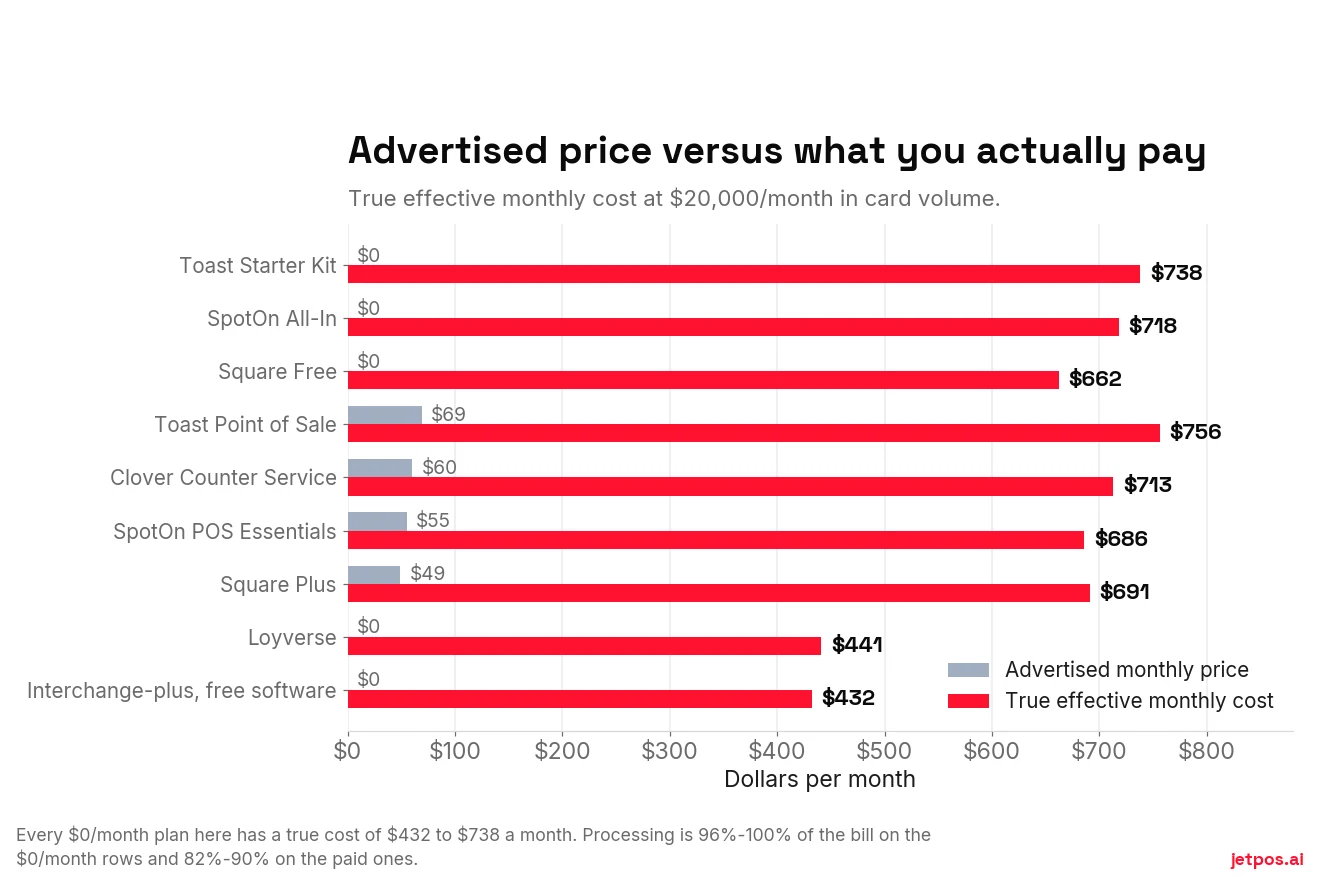
Yes, genuinely free POS software exists, and for a small merchant it's often the cheapest option available. But no POS is free. At $20,000 a month in card volume, "$0/month" plans work out to roughly $430–$740 a month all in — and between 96% and 100% of that is card processing.
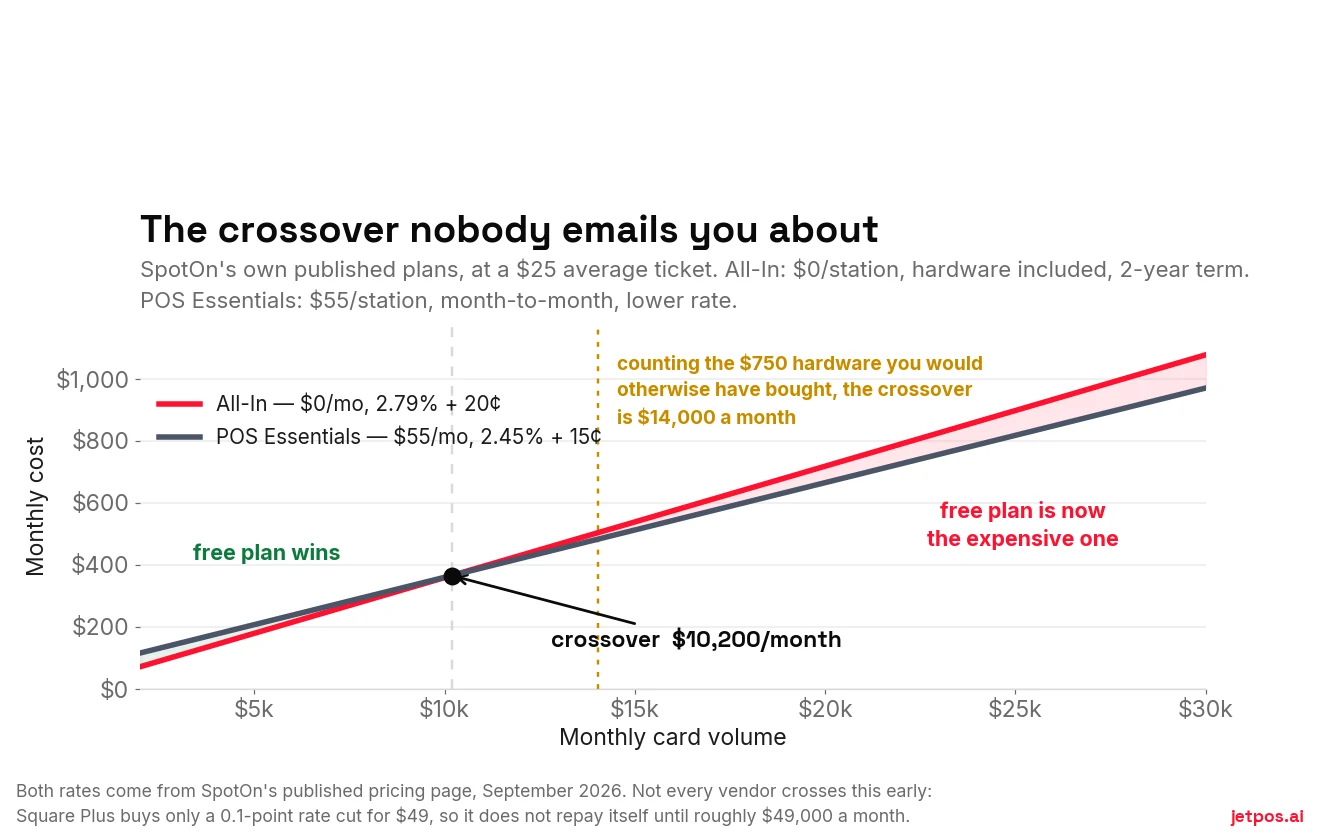
Where the crossover sits depends on which pair you're comparing, so be specific. Against the same vendor's own paid tier, SpotOn's free-hardware plan stops winning at about $10,200 a month in card sales on software alone, or about $14,000 once you count the hardware you'd otherwise have bought. Square's paid tiers are a different animal: Square Plus doesn't repay its own $49 until roughly $49,000 a month. Below your crossover, free-plus-flat-rate genuinely wins. Above it, the free plan is the expensive one and gets more so every month you grow.
The four models
Everything on the market is one of these, or a blend of two.
| Model | Who pays, and how | Where the vendor's margin is | What you give up |
|---|---|---|---|
| 1. Subscription | You, visibly, monthly | Software gross margin (~72% at Toast) | Cash flow. The fee doesn't fall when business is slow. |
| 2. Free software, locked processing | You, per swipe, invisibly | The spread between the flat rate and the true cost | Rate transparency, and any benefit from interchange going down |
| 3. Free hardware, multi-year contract | You, over 24–48 months, in the rate | The rate delta, amortised — plus the exit fee | Exit rights, leverage, and often the hardware itself |
| 4. Pay once | You, upfront, once | The sale, plus optional support | A vendor with recurring revenue to fund maintenance |
Models 1, 2 and 3 are the same business wearing different clothes. Every large POS vendor is a payments company. The subscription is a retention instrument, the hardware is a loss leader, and the processing line is the profit and loss statement.
That's not an accusation. It's in their filings.
The subsidy test, run on public numbers
You don't have to take anyone's word for where the money comes from. Public companies publish it.
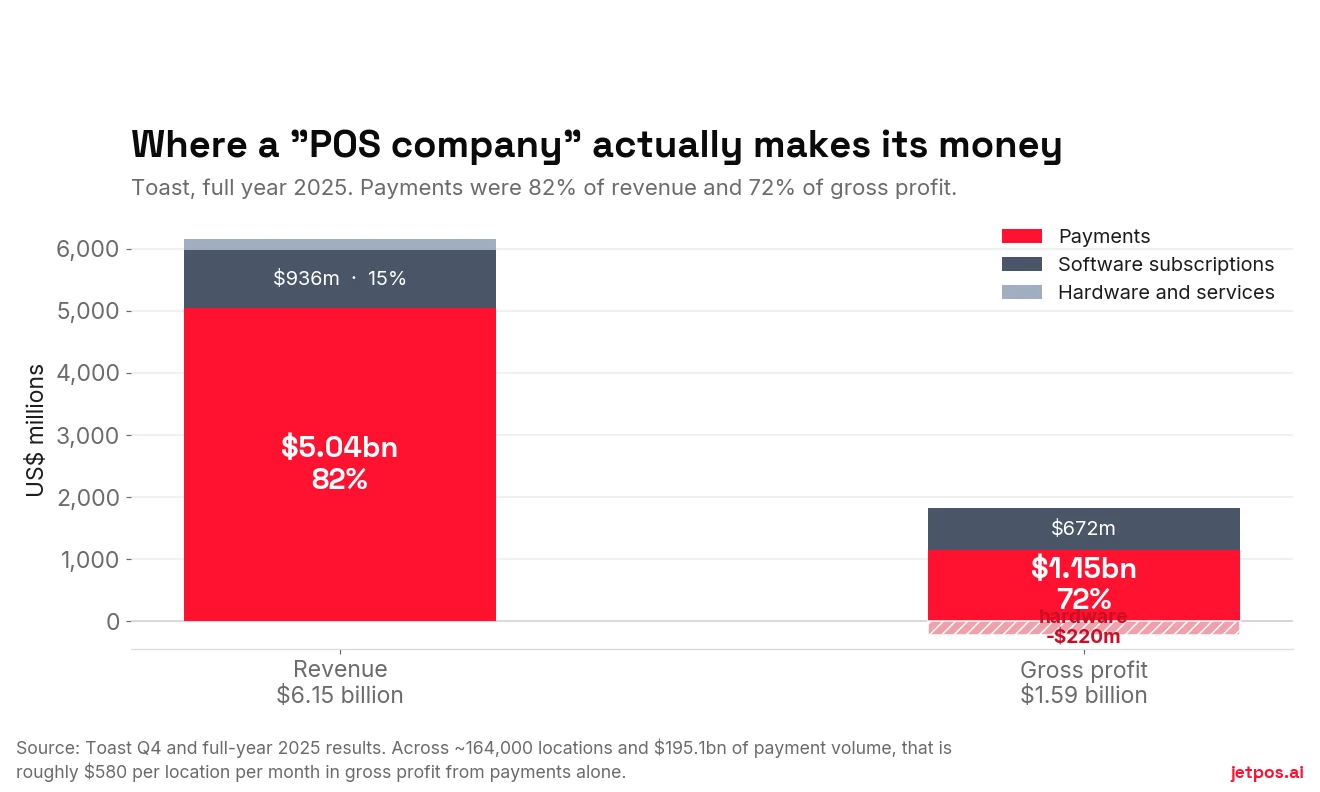
Do the division and it gets sharper. Toast processed $195.1 billion across roughly 164,000 locations in 2025, and its payments segment produced $1.146 billion of gross profit.
That is about $580 per location per month in gross profit from payments alone — more than the $69-a-month plan price trade publications report for Toast Point of Sale, and more than Square's $149 Premium tier. Worth noting: Toast's own pricing page publishes no plan prices at all. It says "starting at $0/month," names a Starter Package, and routes everything else to a sales call. Every Toast price in this guide comes from trade reporting, not from Toast.
Square tells the same story from the other side: Block's 2025 results show Square hardware running at a negative $41 million of gross profit. Lightspeed's fiscal 2026: transaction revenue $815 million against subscription revenue $371 million.
Nobody is making money on the box. Everybody is buying the payment stream.
What it actually costs over three years
Here is the same business — $20,000 a month in card sales, a $25 average ticket, one location — priced across eleven systems using rates published in September 2026.
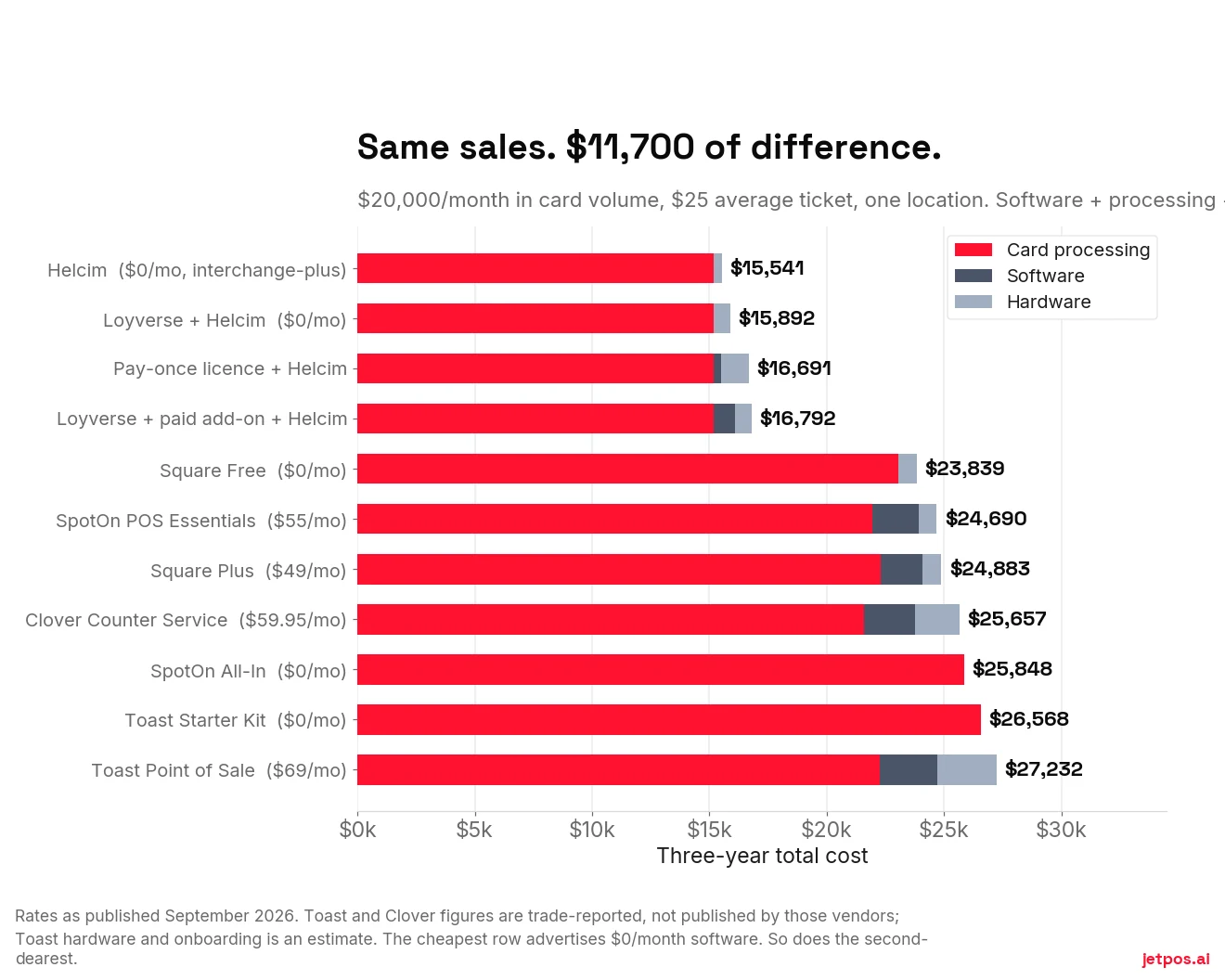
Two things jump out of that chart.
First, a $0/month badge tells you nothing about what you'll pay. The cheapest row — an interchange-plus processor with free software — lands around $15,500 over three years. The second-dearest row, Toast's free-software-and-free-hardware Starter Kit, lands around $26,600. Same sales, same period, an $11,000 gap, and both say $0/month at the top of the page. (The single dearest row is a paid $69/month Toast plan at $27,232, so paying a subscription doesn't rescue you either.)
Second, the subscription is noise. On every single row, processing is between 82% and 100% of the bill — and on the $0/month rows specifically it's 96% to 100%.
When free genuinely wins
We'd rather be useful than absolutist, so: below roughly $10,000 to $15,000 a month in card volume, a free plan with a flat rate is often the correct choice.
At that size the flat-rate spread is smaller than any subscription you'd pay to escape it, and interchange-plus pricing's own fixed costs can eat the difference. A market stall, a seasonal operator, a food truck at $6,000 a month: take the free plan and don't feel clever about it.
The problem isn't the free plan. It's that nobody tells you when to leave it.
The three subsidies, one at a time
Subsidy 1 — free software, paid for in the rate
Benchmark all-in card-present cost — interchange plus assessments plus a competitive markup — runs around 1.79% + 8¢ in the US.
Square Free charges 2.6% + 15¢. At $20,000 a month, that spread is about $218 a month, or $2,600 a year. Toast's pay-as-you-go tier spreads considerably more.
Neither is dishonest. Both are disclosed. But "free" was never the word for it.
In October 2025 Square collapsed 18 separate subscriptions into three plans — Free, Plus at $49 and Premium at $149 per location — and for the first time tied the processing rate to the subscription tier: 2.6%, 2.5% and 2.4%, all plus 15¢.
That's the subsidy made explicit, and it's arguably more honest than hiding it. Two things to know: Square reported that software attach rates nearly doubled among new sellers afterwards, and its own help centre says the switch is one-way — you can't move back to your prior subscription.
Subsidy 2 — free hardware, paid for over two to four years
SpotOn is the rare vendor that publishes both sides of this trade, which makes it computable for once.
Its All-In plan is $0 per station with hardware included, at 2.79% + 20¢, on a two-year term with monthly processing minimums. Its Essentials plan is $55 per station month-to-month at 2.45% + 15¢.
The rate delta is what pays for the "free" hardware. Under roughly $14,000 a month in card volume, taking the free hardware is a rational trade. Above it, it's a slow, quiet loss — and you're locked in for two years while it happens.
The benchmark we price interchange-plus against — 1.79% + 8¢ all-in for card-present — is a weighted average across a typical card mix. If your customers skew towards premium rewards cards or corporate cards, your true cost is higher and the gap to a flat rate is smaller. Interchange-plus hands that variance to you; a flat rate absorbs it. That is the one genuine benefit flat-rate pricing offers, and it's worth something if your card mix is unusual or volatile.
A Clover device is permanently bound to the merchant services provider that sold it and cannot be reprogrammed for another. Switch processors and hardware you paid for becomes worth nothing. Clover also retires devices: reseller notices list Station 2, Station Pro and the second-generation Mini as reaching end of support during 2024, after which they stop receiving security patches. We could not find that schedule on Clover's own site, so treat the specific dates as reseller-reported rather than confirmed — but do ask which generation you're being sold.
When you price "free hardware," price the exit too. We covered the mechanics in the guide to processor lock-in.
Subsidy 3 — the rate increase you can't refuse
A flat rate is a price, not a cost. Which means when the underlying cost falls, nothing reaches you automatically.
Canada ran the clearest natural experiment. From October 2024 the federal government's agreements with Visa and Mastercard cut in-store interchange for eligible small businesses to a 0.95% weighted average — a roughly 27% reduction covering more than 90% of card-accepting businesses.
The CFIB then documented which processors would actually pass it on. Chase, Global Payments, Moneris, Square and TD committed. Several were unclear. At least one said it would keep the savings.
Under flat-rate pricing, a cost decrease is a vendor margin increase unless someone chooses otherwise.
Interac debit interchange on a chip insert is effectively zero. A percentage-based flat rate charges a percentage on a card that costs the processor almost nothing.
If most of your volume is Interac debit — which for a lot of Canadian retail and QSR it is — a flat rate is a worse deal in Canada than the same rate would be in the US, and the free-POS listicles written for a US audience will not tell you that.
The honest case for paying
Three situations where a subscription is genuinely the cheaper answer, and we'd say so even though it isn't our model.
- When the subscription buys a lower rate and your volume repays it. Square Plus at $49 a month buys a 0.1-point rate cut, which only pays for itself above roughly $49,000 a month in card volume. Above that line, upgrading is simply correct.
- When the subscription buys processor freedom. Some paid systems take no cut of payments at all and let you shop the rate. At $20,000 a month, being able to negotiate is worth roughly $2,600 a year — considerably more than the subscription.
- When a free plan withholds something you actually need. Multi-terminal permissions, staff roles, returns and exchanges across locations, real reporting. Find out which of those sit behind the paywall before you build your catalogue on the free tier.
Now run the test on us
JET is a $0/month POS. So: where's our revenue?
Hardware, once. You buy a station — a Topaz 2.0 or an Onyx MAX, list $1,299 and $1,800 (the Topaz 2.0 is currently out of stock and on pre-order at $1,199, shipping in 30 to 45 days) — and that's the transaction. The software comes with it, every feature unlocked, no monthly fee and nothing behind a paywall.
We don't sell you processing. JET POS takes no percentage of your card sales and earns nothing from your processor, so you bring your own and shop the rate. Be aware of the corporate picture, though: JET is a brand of Solvr Solutions Inc., which also operates as a payment-processing agent under separate agreements. Those are different products with different paperwork — but if you'd rather know that than not, now you do. Nothing about buying a JET station obliges you to buy processing from anyone.
That's the whole model. Now the part most vendor pages skip.
One-time revenue has to fund ongoing work. A subscription vendor gets paid every month to keep the software alive. We get paid once. That's a genuine question you should put to us, and to any pay-once vendor: what funds maintenance in year five?
Our answer is that AI has changed the cost of building and maintaining software enough to make this viable — which is a real argument, and we've laid out the evidence for it in a separate guide rather than asking you to take it on faith.
And the cautionary tale is real. Intuit discontinued QuickBooks Desktop Point of Sale on 3 October 2023. Merchants had bought that software. On that date the payments service, gift cards, the ecommerce integration and live support all stopped, and Intuit noted plainly that discontinued products don't receive security patches. The software kept opening. The business around it did not.
Buying a licence buys you the code, not the company. That's true of us as much as anyone, and you should ask us the same questions you'd ask them.
Two more things we should say plainly. JET has no kitchen display system — restaurants route tickets to a kitchen printer instead, and we've written an honest comparison of when that's fine and when it isn't. And the app is Android only. If either is a dealbreaker, better to find out here.
How to price a real quote in ten minutes
- Take your last statement, not an estimate. Monthly card volume and transaction count, both real numbers.
- Compute processing for each option: volume × rate, plus transactions × per-transaction fee. This is the number that matters and it's the one nobody puts in a quote.
- Add software × 36. Per location and per device — count every screen, handheld and kiosk.
- Add hardware, or the lease total if it's financed. If it's "free," find the term and the rate delta that's paying for it.
- Add the exit. Termination formula plus any hardware you'd have to replace. A locked terminal is a switching cost, so price it as one.
- Run it again at 1.5× your current volume. This is the step everyone skips, and it's the one that reveals which plan you'll regret.
What we'd do on Monday
Find your monthly card volume and your transaction count. Multiply volume by each vendor's rate, add transactions times their per-transaction fee, and put the subscription next to it. Five minutes, and you'll know more than any comparison page can tell you — including this one, because we don't know your average ticket.
Then ask every vendor on your shortlist one question: "where does your revenue come from?" The good ones answer immediately.
For a side-by-side version of this comparison, WHICHpos covers no-monthly-fee systems with its scoring method published.
Disclosure: WHICHpos is published by Solvr Solutions Inc. — the same company that makes JET. It is a sister site, not an independent referee. Read its scoring method and check its figures against the vendors’ own pages before you weigh anything it says about us.