

Every POS vendor put "AI-powered" on its homepage this year. So we spent a while finding out which claims survive contact with independent evidence.
The short version: one capability is genuinely new and genuinely useful. Several are thirty-year-old techniques with a new badge. One or two are marketing. And there's a graveyard nobody puts on the slide — including a computer-vision system that a very large coffee chain rolled out across North America and killed nine months later.
The short answer
In 2026, AI in a POS mostly means one new thing: you can ask your sales data questions in plain English and get an answer without building a report. Everything else marketed as AI is a decades-old statistical forecast, a barcode-to-database lookup, an OCR scanner, or a text generator for menu descriptions.
Useful, occasionally excellent — but rarely new, and rarely a reason to switch systems. Nearly every vendor now includes it free, for a reason we'll show you with a chart.
First, how much of this is even in use
The National Restaurant Association's 2026 industry survey found 26% of US operators using any AI-related tool. Marketing was the most common use at 19% for full-service. Customer ordering — the thing that gets all the coverage — was 6%.
And when Toast published what 179,000 of its own users actually asked its assistant in a quarter, the pattern was unmistakable. Sales and revenue analysis: 47%. Menu and inventory: 34%. Guest and marketing: 32%.
The single most common prompt was a request for a short daily briefing.
The thirteen features, sorted
Verdicts below are ours; the evidence column is what they rest on.
| Feature | What it actually is | Verdict | Evidence quality |
|---|---|---|---|
| Natural-language reporting | The model writes a database query; the database does the maths; the model narrates | Real | Strong on adoption, no vendor publishes accuracy |
| Fraud / chargeback scoring | Classifier trained on labelled chargebacks across many merchants | Real | Oldest legitimate ML in payments; vendor-reported outcomes |
| Invoice / receipt OCR | Text recognition, then fuzzy-matching line items to your catalogue | Real | Mechanism solid; almost no published time savings |
| Menu copy and marketing text | A language model writes text from a prompt | Real | Uncontested. Cheapest feature to build, safest to demo |
| Voice / drive-thru ordering | Speech recognition, intent parsing, menu mapping | Real but underperforming | Independently measured — and worse than humans on accuracy |
| Demand forecasting | Regression on your own history, with covariates | Semi-real | Strong academic evidence at scale; zero SMB accuracy figures |
| Inventory par / auto-reorder | Forecast × recipe depletion → reorder point | Semi-real | Weak. Depends entirely on your recipe discipline |
| Menu and price engineering | Margin × velocity ranking — the 1980s Boston matrix, narrated | Semi-real | No independent evidence |
| Shrink / anomaly detection | Z-scores on voids, comps and refunds per employee | Semi-real | Right target, but the industry's headline shrink data was withdrawn |
| Support chat deflection | Retrieval over a help centre plus a generated answer | Real for the vendor | "Resolution" is rarely defined; Gartner disputes the cost saving |
| Agentic / conversational ordering | A protocol letting an AI agent hand a cart to your backend | Real, but e-commerce | Live on marketplaces; no restaurant-POS implementation found |
| Barcode "product recognition" | A 1974 symbology decode plus a database lookup | Not AI | The most commonly mislabelled feature in the category |
| Computer-vision checkout / stock counting | Camera fusion inferring take-and-put events | Vapor for an independent | A major chain deployed and killed it inside nine months |
The one number that contradicts the marketing
Voice ordering is the only AI category where somebody independent has actually measured the thing. Intouch Insight ran 165 mystery-shop visits per brand across 13 QSR chains in 2025.
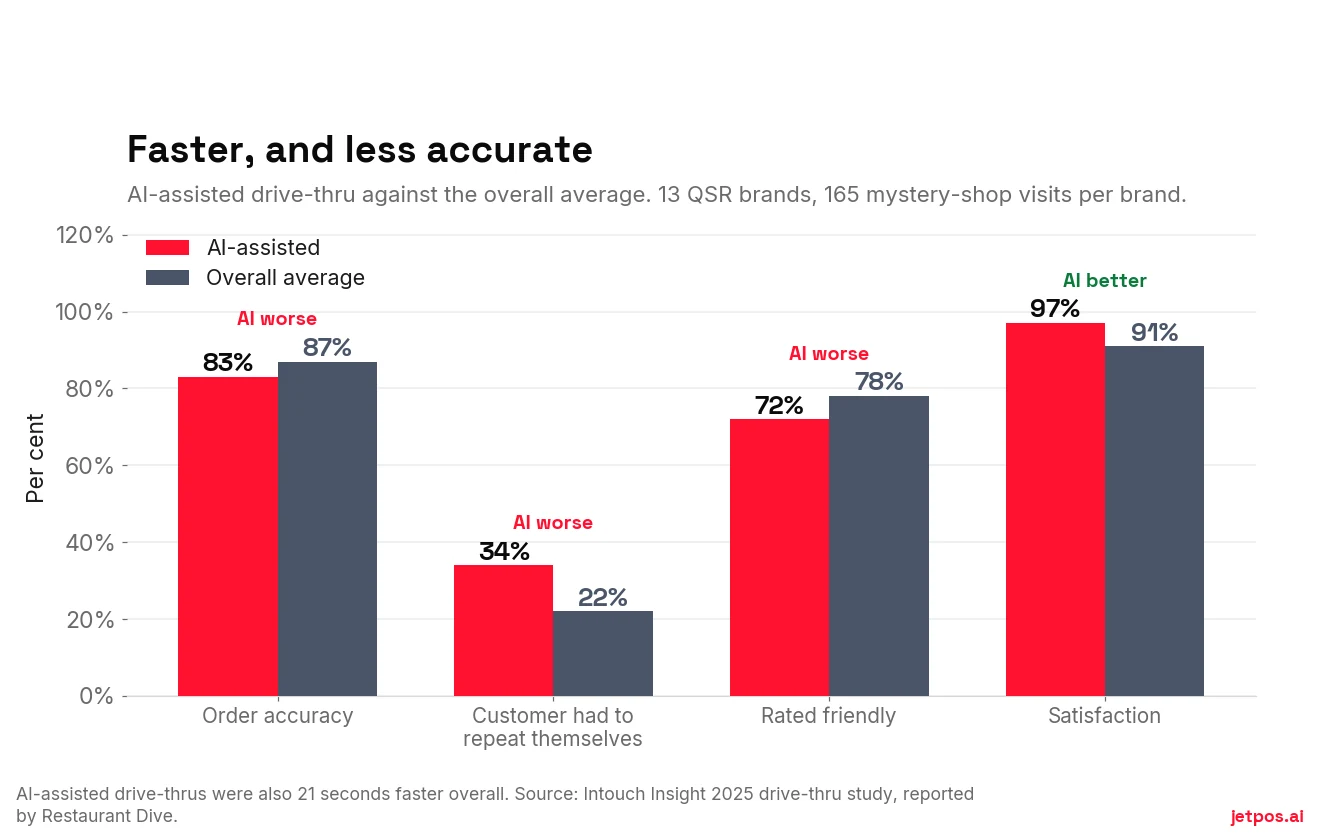
Twenty-one seconds is real and worth money at scale. So is four points of order accuracy, in the other direction.
The deployment record says the same thing more bluntly. McDonald's ended its IBM drive-thru voice partnership in 2024 after about three years. Yum slowed its own rollout in 2025 after customers worked out how to abuse it — one order was for 18,000 cups of water. Taco Bell is nonetheless live in 890+ locations across 38 states, so the technology is not dead. It's just not what the slide says.
The graveyard
Vendors publish launches. Nobody publishes the ending.
In September 2025, Starbucks began rolling a computer-vision inventory system across its North American company-operated stores. Cameras plus 3D spatial mapping, counting stock eight times more frequently than manual counts. It was covered as a milestone.
In May 2026 it was discontinued. Staff described it as unreliable; it miscounted and mislabelled items.
Nothing about that is disgraceful — it's what a real trial looks like. But if the company with that budget and that store control couldn't make camera-based counting work in nine months, treat the same pitch to an independent grocer accordingly.
Two more worth knowing. Toast's own blog describes demand forecasting and labour scheduling as capabilities — and Restaurant Dive reported in August 2026 that they are "future products in development," not shipped. And a Pizza Hut franchisee has sued over a mandated AI delivery system, alleging its market's sales swung from +10% to −10% after deployment. Those are untested allegations, but the existence of the suit is itself information.
Why every vendor gave you an AI assistant free this year
This is the most useful thing in this guide, and it isn't about POS at all.
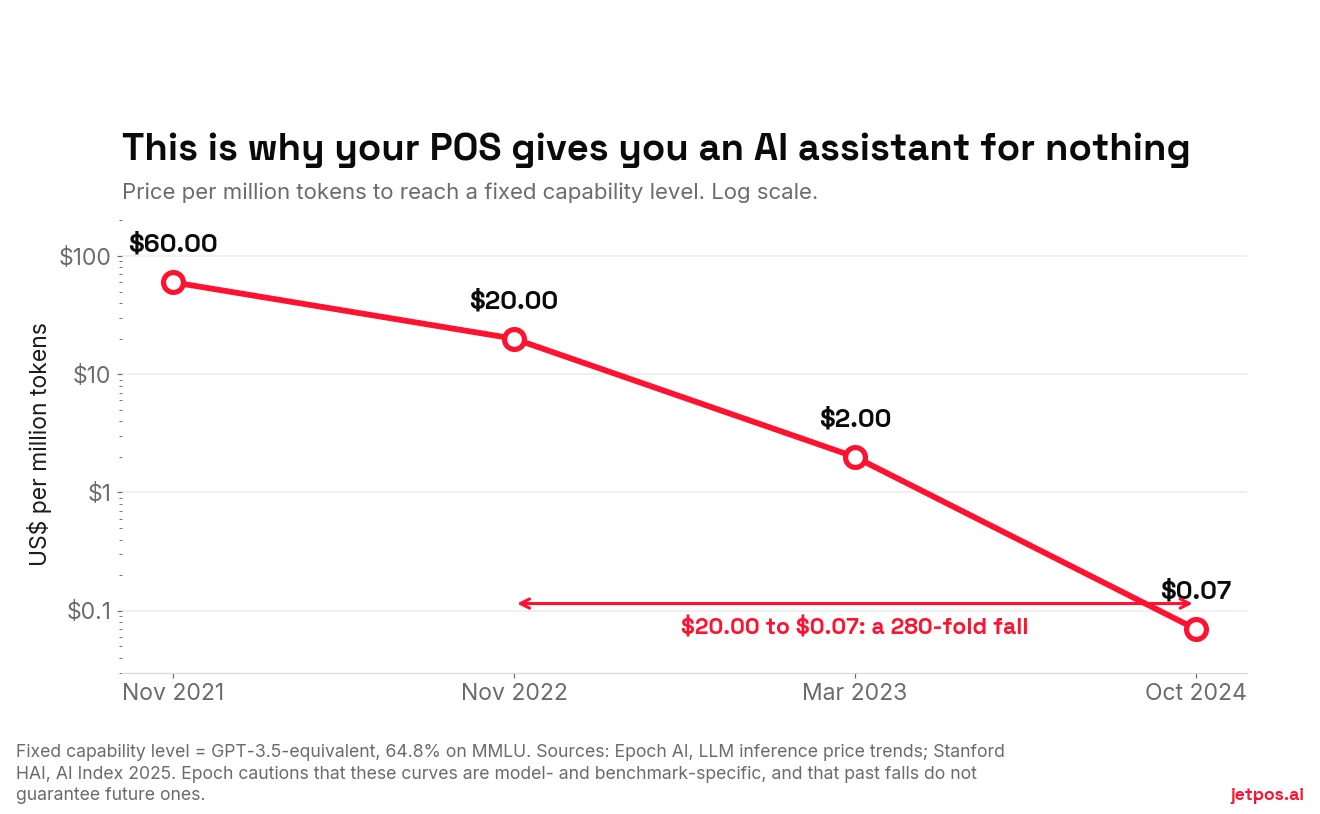
A natural-language question over a restaurant's sales data is a few thousand tokens. Fractions of a cent.
That is not generosity and it isn't a loss leader. The marginal cost went to nearly zero, so the feature became free to serve — which is why Square, Toast, Lightspeed and Shopify all shipped essentially the same conversational assistant within about fourteen months of one another.
That synchrony is the evidence. It wasn't competitive genius. It was a cost curve crossing a threshold at the same moment for everybody.
Inference cost was never the binding constraint on POS feature velocity. What made a POS feature expensive in 2020 was integration work, payment certification, hardware qualification, multi-tenant QA across a thousand configurations, regulatory compliance and the support burden that follows a shipped feature into production for a decade.
None of those fell 280-fold. None of them fell at all. One of them arguably got worse: the 2025 DORA report found AI adoption correlated negatively with delivery stability.
So the honest version of the story is much narrower than the marketing version. What changed is that one category of feature — a per-merchant natural-language analyst — went from impossible at any price to nearly free to serve. That is a real and interesting change. It is not "AI made building a POS cheap," and any vendor implying otherwise, including any vendor whose logo is at the top of this page, is overselling it.
And here's the buyer's corollary: if every vendor shipped it in the same year because it got cheap, it isn't a differentiator — and nobody should be charging you extra for it. Note which ones do.
Now the argument we make, and the evidence against it
JET's positioning is that AI changed what a small team can build and maintain, which is how you get a hundred-plus features with no monthly subscription. We believe that. Here's the honest state of the evidence.
Inference cost collapsing is not in dispute. That part is as well-documented as anything in this article.
AI-assisted development is genuinely contested, and the two best controlled studies point in opposite directions.
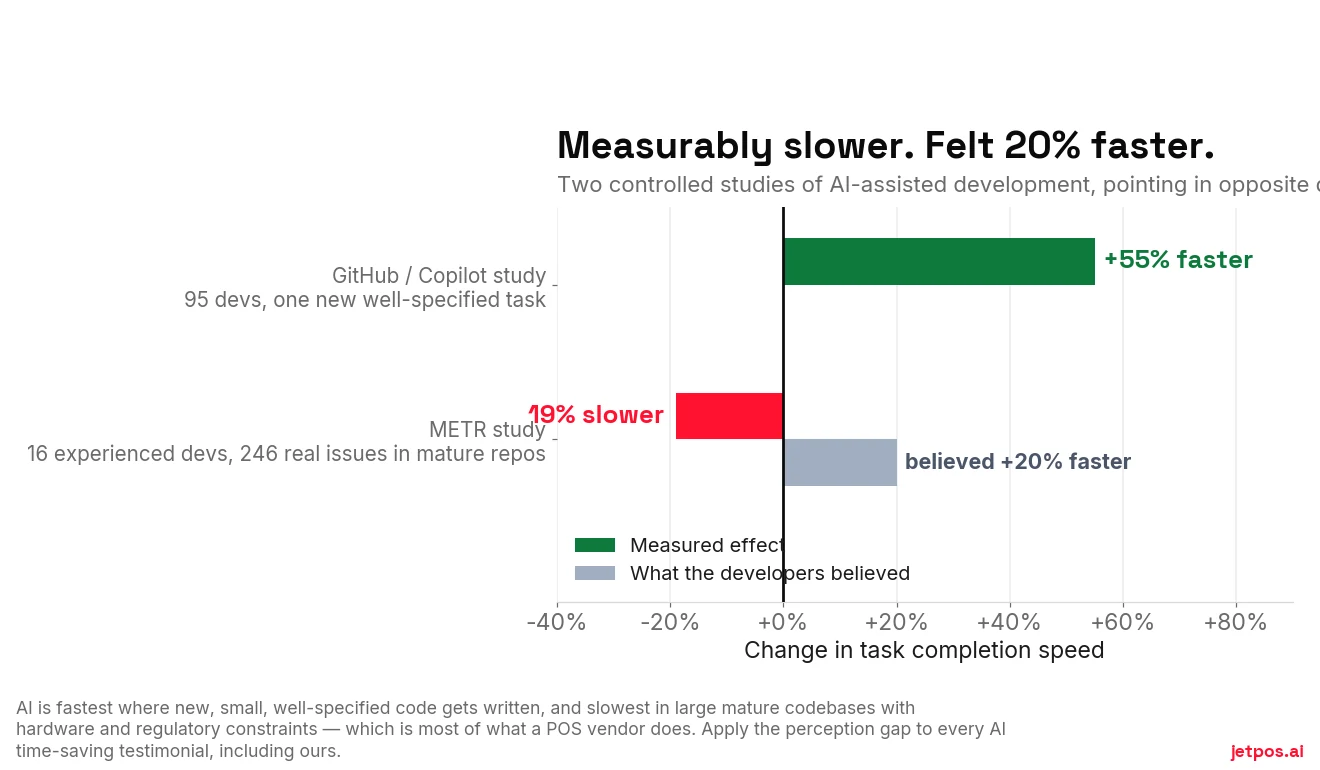
The reconciliation isn't that one study is wrong. AI is fastest exactly where new, small, well-specified code gets written, and slowest in large mature codebases with deep domain context, hardware integrations and regulatory constraints — which describes most of what a POS vendor does.
The industry-wide picture agrees with both: the 2025 DORA report found 90% of developers using AI and more than 80% believing it raised their productivity, while AI adoption correlated negatively with delivery stability. Its own summary line is the fair one: "AI doesn't fix a team; it amplifies what's already there."
Not "AI wrote our software." The narrower claim is the one the evidence supports: a category of capability that was uneconomic at small-business prices is now nearly free to serve. Nobody could have given every merchant a private analyst in 2020 at any price. Today it costs fractions of a cent per question.
That changes what a hardware-funded business can afford to include, which is our actual argument for shipping everything unlocked at $0 a month. It doesn't mean maintenance became free, and we'd rather you held us to the narrow claim than the wide one.
How to test an AI claim in a demo, in five questions
Twenty minutes, and it works on any vendor.
- "Show me the query." Ask the assistant something specific, then ask it to show the query or filter it used. If it shows you, a database that can't hallucinate did the arithmetic and the model only translated and narrated it. If it just states a number, a language model is doing your accounting.
- "What's your forecast error against 'same weekday last week'?" That naive baseline is genuinely strong. A vendor that has measured itself against it will tell you. A vendor that hasn't will change the subject.
- "Is that barcode lookup or image recognition?" Then: "what's your catalogue coverage on private label and produce?" That's the real answer to the "99% recognition" claim.
- "Is this included, or an add-on, and what happens if I hit a usage limit?" Most assistants are included. Some marketing agents are not. Get it in writing.
- "What data does this need from me, and over what period, before it's any good?" Anything forecast-shaped needs 12 to 24 months of clean history plus price, promotion and event data. A vendor who says "it works from day one" is describing a moving average.
What's actually worth your attention
- Natural-language reporting — if it shows its work. This is the one genuinely new capability, and the one operators actually use.
- Invoice OCR — the most reliably useful AI feature in a POS, provided you check the line-item matching. The failure mode is a correctly-read invoice attached to the wrong SKU, and it corrupts your food cost silently.
- Fraud scoring — real, and it works because your processor sees millions of merchants, not because your POS is clever. Ask your processor about it, not your POS vendor.
- Menu and marketing copy — genuinely good, genuinely cheap, and you should not pay a premium for it.
- Forecasting — worth having if you'll feed it price, promotion and event data. Otherwise it's a moving average with a nicer chart.
And since you should apply this to us: which of the thirteen do we actually ship?
Fewer than our marketing implies, which is the point of putting it here.
Catalogue building by barcode. Scan a product's barcode and the system fills in the name, so you only add a price. It works for the overwhelming majority of branded packaged goods. It is a database lookup, and we'd rather call it that than call it AI — it will not recognise your private-label jam, and no vendor's will.
What we do not ship: voice ordering, computer-vision checkout or stock counting, dynamic pricing, and a kitchen display system of any kind. If a feature above isn't named here, assume we don't have it and ask us before you buy.
Our AI claim is about how the software gets built and maintained, not about a checkbox in the product — which is exactly the sort of claim that deserves the scepticism the rest of this page applies to everyone else. The evidence for and against it is in the section above; we've published the study that argues against us.
What we'd do on Monday
Open whatever assistant your current POS already includes and ask it three real questions about last month. You've probably already paid for it.
Then ask it to show you the query. That single request tells you more about a vendor's engineering than any feature page.
For a vendor-by-vendor scoring framework, WHICHpos publishes its methodology, including the weight it gives to features versus cost.
Disclosure: WHICHpos is published by Solvr Solutions Inc. — the same company that makes JET. It is a sister site, not an independent referee. Read its scoring method and check its figures against the vendors’ own pages before you weigh anything it says about us.