

In July 2022 the Federal Trade Commission sued a payment processor over what it charged small businesses to leave.
The complaint describes a standard agreement binding merchants to a three-year term with a $495 early termination fee, and an enrolment platform where — as pleaded — a merchant could complete the whole process and sign without ever encountering the term or the exit fee. The fee summary, the FTC alleged, had never included the termination fee at all.
The FTC also alleged that sales pitches were delivered in merchants' native languages while the paperwork existed only in English. Those are allegations from a complaint, and the defendants settled without admitting them.
The case settled for $4.9 million, with the defendants neither admitting nor denying the allegations, and an injunction permanently barring collection of those exit fees from merchants who enrolled through that platform before April 2020.
That's an outlier, and it's not the reason to read this. The reason is that most of what made it work — a term you didn't notice, a renewal you didn't diarise, an exit priced as a formula rather than a number — is standard, disclosed, and entirely legal.
The short answer
Usually you can get out, but the price depends entirely on which clause governs. A flat early termination fee runs roughly $295–$800. A liquidated damages clause instead multiplies your average monthly fees by every month remaining, which routinely produces $10,000 to $100,000+. A separate non-cancellable equipment lease survives either way, and often survives the business closing.
Read all three documents before you give notice — and check whether a recent fee increase has already opened a penalty-free exit with a deadline on it.
You didn't sign a contract. You signed four.
This is the structural fact that makes everything else work, and neither of the two best guides we found on this topic mentions it.
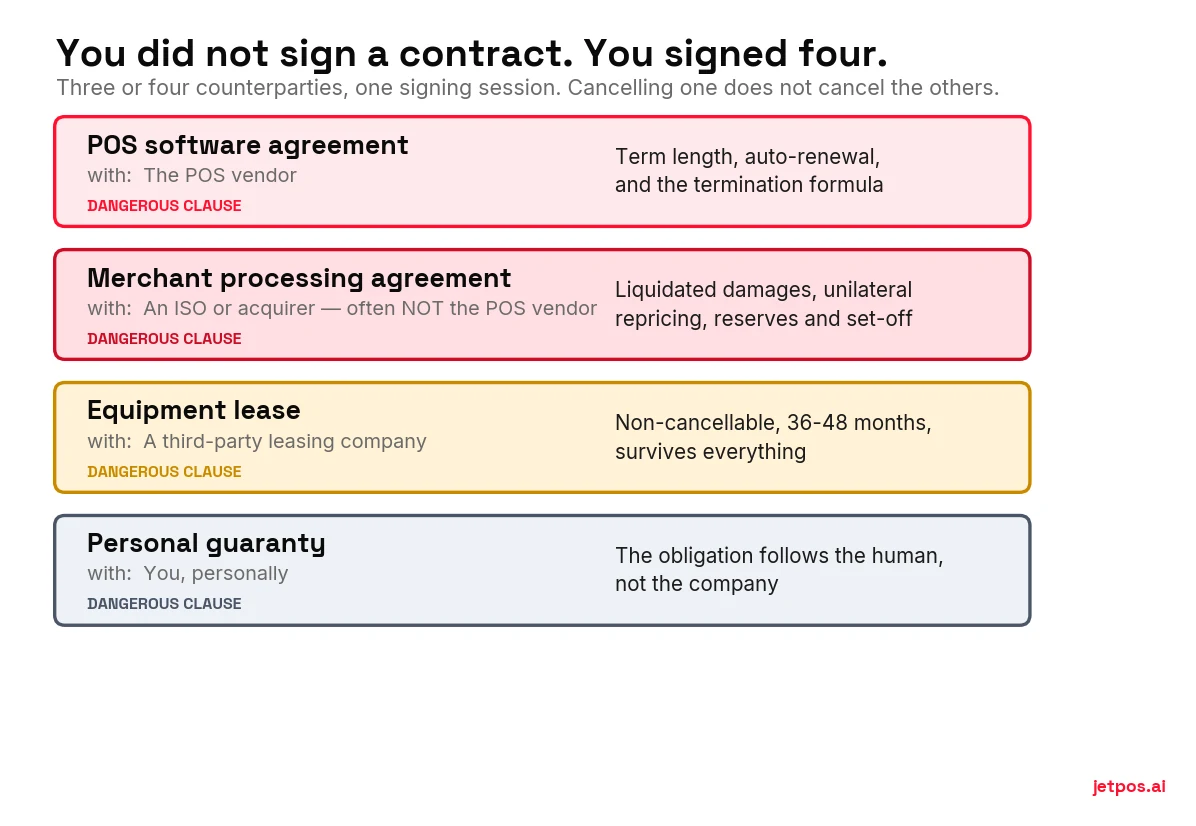
| Document | Who it's with | The dangerous clause |
|---|---|---|
| POS software agreement | The POS vendor | Term length, auto-renewal, and the termination formula |
| Merchant processing agreement | An ISO or acquirer — often not the POS vendor | Liquidated damages, unilateral repricing, reserves and set-off |
| Equipment lease | A third-party leasing company | Non-cancellable, 36–48 months, survives everything |
| Personal guaranty | You, personally | The obligation follows the human, not the company |
When people say "my POS company," they usually mean up to four different businesses, only one of which they've ever spoken to. Cancelling one doesn't cancel the others.
The two exit fees, and why one is 100× the other
The flat fee
A number. Typically $295 to $800 depending on whose survey you read, sometimes prorated downward by roughly $100 for each completed year.
Annoying, budgetable, and not the problem.
Liquidated damages
Not a number — a formula. Your average monthly fees × months remaining, usually averaged over the last six or twelve months, often with a floor such as "or $350, whichever is greater."
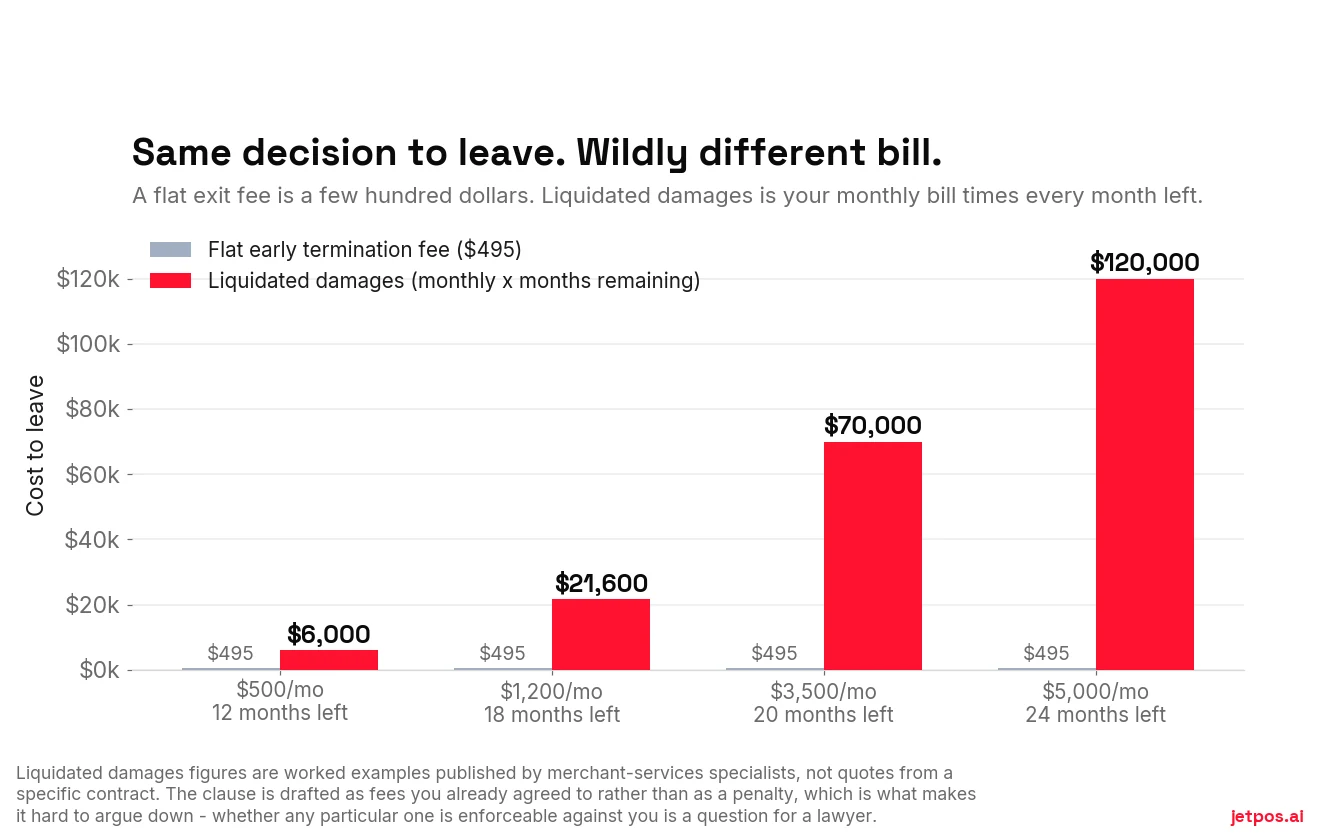
It is the single most expensive clause in small-business payments, and it never appears in a sales conversation.
Is it enforceable? Don't plan on the answer being no. The clause is drafted to look like fees you already agreed to rather than a punishment, which is precisely what makes it hard to fight. Courts in many jurisdictions will refuse to enforce a liquidated-damages clause that operates as a penalty rather than a genuine pre-estimate of loss — but that is fact-specific and jurisdiction-specific, and in researching this guide we found no case striking one down in a POS or merchant-services contract. Treat "is this actually enforceable against me?" as a question for a lawyer who has read your document, never as a defence you can rely on while you stop paying.
"Is the termination fee a fixed number, or is it calculated from the remaining term? Show me the clause."
Anyone who answers "it's minimal" or "we've never charged it" has not answered. Get the clause, in writing, before you sign.
The lease is worse than the contract
A card terminal costs somewhere between $150 and $400 to buy outright. It is commonly leased at $59 to $99 a month for 36 or 48 months.
Forty-eight months at $99 is $4,752.
Industry material aimed at resellers explains why they're pushed so hard. Lease pricing uses a factor rate against the equipment cost, and a single lease can generate roughly $600 of upfront commission for the salesperson. That commission is paid on the lease, not on the hardware — which is why "the terminal is free, there's just a small monthly" is one of the most expensive sentences in this industry.
And leases are, in the words of one industry explainer, "non-cancellable, and there are no exceptions. None." Cancelling your processor doesn't touch it. Closing the business frequently doesn't either, because of the guaranty.
In 2020 the New York Attorney General won a judgment against a terminal-leasing company over its non-cancellable lease programme. The court vacated 29,617 default judgments against small businesses and rescinded the leases, and the AG's office reported that roughly 95% of the businesses sued were out of state and couldn't afford to appear in a New York court to defend themselves.
Monetary judgments exceeding $680 million followed in 2023. In 2024 the AG announced over $4.6 million actually recovered — and separately obtained judgment against successor entities the owners had set up to continue the same conduct.
The targets were flower shops, salons, delis, repair shops and restaurants. Lease terms of 48 to 60 months, at a total cost reported as up to ten times what the equipment would have cost to buy.
What the major vendors' own terms say
The Square, Toast and SpotOn rows are quoted from those companies' own published agreements, September 2026. The Clover row is different: Clover contracts are written by thousands of independent resellers, not published centrally, so that row comes from third-party reviews and merchant reports rather than a document Fiserv publishes — treat it as the typical shape, not as terms you can hold anyone to. Your own order form governs in every case.
| Vendor | Term | Auto-renewal | Exit fee | Notable clause |
|---|---|---|---|---|
| Square | None | N/A | None | May amend terms at any time; may hold funds and exercise set-off across accounts |
| Toast | Per order form | 1 year, 30 days' notice to stop | All remaining subscription fees; $150 × months on pay-as-you-go | May change processing rates on 30 days' notice. Trade reporting reads §6.2 as also opening a termination right if you cancel in writing first — unverified; ask |
| SpotOn | Per plan | Per plan | All fees for all unpaid months remaining | Hardware back within 15 business days; discount clawback if you leave inside 2 years; may terminate on a fee change if you object first |
| Clover (via resellers) reported | Commonly 36–48 months | Varies by reseller | ~$295–$595 reported | Contract is with the reseller, not Fiserv — and the hardware can't move |
Two observations worth making, because they cut both ways.
Square's contract is genuinely the cleanest of the closed systems. No term, no exit fee, cancel from account settings. That's a real advantage and it deserves saying. What it trades is flexibility elsewhere: Square can amend the terms at any time, and its payment terms reserve the right to restrict proceeds temporarily or indefinitely and to exercise set-off across your accounts. Free to leave, less free while you're there.
Treat any rate-increase email as a countdown clock, not just bad news. Toast's agreement lets it reprice card processing on 30 days' notice; SpotOn's terms explicitly let you terminate by objecting before a fee change takes effect. Trade reporting in August 2026 read Toast's §6.2 the same way — a right to terminate on a fee-increase notice, but only if you cancel in writing before the fees take effect. We could not verify that against a current Toast agreement. So the move when the email lands is the same either way: pull your agreement, find the fee-change clause, and if there's an exit in it, use it before the date passes. The window is short and it does not reopen.
Canada's Code of Conduct for the Credit and Debit Card Industry does what no US statute does. Since October 2024:
- 30 to 60 calendar days' notice of any fee increase, and the notice must tell you about your cancellation right.
- 70 calendar days from the effective date of a fee increase to cancel without penalty.
- Auto-renewal capped at extensions of six months or less, with non-renewal notice permitted up to 45 days out.
- A related services agreement cannot exceed the duration of the primary agreement (Policy 7).
- Complaints acknowledged within 5 business days and answered within 20.
Now the limit on that fourth bullet, because it matters more than the bullet. The Code binds the payment card networks and their acquirers. It attaches to your merchant-acquirer relationship. An equipment lease written by an independent third-party leasing company — which is where the worst terms live — is not a party to the Code and sits outside it. So Policy 7 is real leverage where the "related service" was bundled into the relationship by your acquirer, and no help at all against a standalone lease from a finance company you'd never heard of before you signed. Do not assume a Canadian address protects you from the lease. Read the lease.
One US state deserves a mention too: New York's General Obligations Law § 5-903 requires a provider to give a business 15 to 30 days' written notice, by certified mail, before an automatic renewal — or the renewal is unenforceable. Renewals of a month or less are exempt. The statute is written around service contracts, and whether your particular POS or processing agreement is the kind it covers is a question for a lawyer rather than something to assume. But if you're a New York business that got auto-renewed with no certified-mail notice, it is absolutely worth raising.
The small fees that ride along
Two worth knowing because they're pure margin and easily fixed.
PCI compliance fees average around $120 a year. Ask what it actually buys — scans, breach coverage, a portal? Some processors charge nothing at all, which tells you it's a pricing choice rather than a cost.
PCI non-compliance fees are different: a monthly penalty for not having filed your self-assessment questionnaire. It buys you nothing. Industry average is $20 to $30 a month; one named processor charges $94.95, which is over $1,100 a year for a form you didn't fill in. Fill in the form.
The exit playbook
- Find all four documents. Software agreement, processing agreement, lease, guaranty. If you can't find them, request them in writing from each counterparty, and download everything from the portal before you cancel — portal access usually disappears with the account.
- Write down five numbers. Term end date. Renewal period. Notice required, in what format, to whom. Termination formula. Lease payoff balance. That's the whole picture on one index card.
- Check for an open escape hatch. Has a fee-increase notice landed in the last 30 days? Most agreements give a termination right over a repricing, and in Canada you have 70 days by rule. This is the cheapest exit that exists — and it expires.
- Export everything before you say a word. Catalogue, customers, sales history, gift-card balances, loyalty points. Cooperation drops sharply once you've given notice. The migration runbook covers exactly what to pull.
- Give notice the way the contract says. Written, to the named recipient, inside the window. Certified mail or a delivery-tracked email if it says "received by." Keep proof. A cancellation that doesn't meet the formal requirement is not a cancellation.
- Return the hardware and prove it. Deadlines are real — SpotOn's terms give 15 business days before replacement charges apply. Ship trackable, photograph the serial numbers, keep the delivery confirmation.
- Watch your bank account for 90 days. Set an alert. Fees sometimes continue after termination, and occasionally under a different billing name than the one you recognise — that was part of the FTC's case.
- If it goes wrong, escalate in this order. Written demand to the provider, then your state attorney general and the FTC, then the BBB, then your card network's merchant complaint channel, then small claims. Not the CFPB — its complaint categories don't cover merchant services, because you're a business, not a consumer.
Termination fees are frequently negotiable, especially if you're not disputing the bill, you're within a few months of the term end, or the provider has recently repriced you. "I'd like to leave on good terms — what can you do on the termination fee?" costs one phone call and is answered yes more often than people expect.
Weigh the fee against the saving, honestly. If the exit costs $2,000 and the switch saves $400 a month, that's a five-month payback and you should go. If it saves $60 a month, wait for the renewal date and put a calendar reminder 60 days before it.
Ten clauses to read before you sign the next one
- Term length — and whether the hardware has its own, different term.
- Auto-renewal — the period, the notice window, the required format, the recipient.
- Termination — a number or a formula? Get the formula.
- Repricing — can they raise your rate unilaterally, with how much notice, and does that open a termination right for you?
- The lease — who is the lessee, is it non-cancellable, what's the total of payments, and does it survive cancellation of everything else?
- Personal guaranty — usually a block just above the signature line. Look for "Individual Guarantor."
- Reserves, holds and set-off — under what conditions can they hold your money, and for how long?
- Hardware return — deadline, RMA requirements, and the charge if a device isn't returned.
- Exclusivity — any obligation to use their processing, and the fee if you don't.
- Dispute resolution — arbitration clause? Class-action waiver? Which state's courts?
Where JET sits
There's no contract to get out of. You buy a station, the software comes with it at $0 a month, and there's no term, no auto-renewal, no termination fee and no lease. If JET stops being right for you, you stop using it — and you still own the hardware you paid for.
Two honest caveats. That model means we get paid once, which is a fair question to put to us and one we answered in public rather than glossing over. And "no contract" cuts both ways: we're not contractually bound to you for three years either. We think that's the right trade — a vendor that has to keep earning it is a better vendor — but you should know which one you're choosing.
What we'd do on Monday
Find your agreement. Write down the renewal date, the notice window, the termination formula and the lease balance. Fifteen minutes, one index card.
Then put the notice deadline in your calendar with a 60-day warning. Not the renewal date — the notice deadline, which is 30 to 90 days earlier and is the one that actually matters.
That single calendar entry is the highest-return fifteen minutes in this entire guide. It converts a decision someone else controls into one you do.
For a vendor-by-vendor view of contract terms and lock-in, WHICHpos covers it across nine systems.
Disclosure: WHICHpos is published by Solvr Solutions Inc. — the same company that makes JET. It is a sister site, not an independent referee. Read its scoring method and check its figures against the vendors’ own pages before you weigh anything it says about us.