

Pull last month's merchant statement. Find total fees, find total card volume, divide one by the other. Almost nobody does this, and it is the only number in the whole document that matters.
Most operators who run it for the first time get a number they did not expect. They were quoted 2.6%. The statement says 3.4%, or 4.1%, or worse. Nothing was stolen. Every one of those charges was disclosed somewhere — in a rate sheet, a schedule A, a lease, a clause about auto-renewal.
The disclosure just wasn't the same document as the price.
The short answer
Hidden POS fees sit in four layers: processing markup buried inside a flat rate, recurring charges per terminal and per location, add-on modules billed separately, and exit costs that only appear when you try to leave. The advertised monthly price typically covers less than a third of the true three-year total.
The single most useful thing you can do this week is calculate your effective rate: total fees ÷ total card volume. Everything below explains the gap between that number and the one you were quoted.
The four layers of a POS bill
Vendors compete loudly on layer two and quietly on layer one. That is not an accident — layer one is where the money is.
| Layer | What it is | How visible | Share of a typical 3-year cost |
|---|---|---|---|
| 1. Processing | A percentage and a few cents on every card sale | Quoted as one number that hides three | Usually 70–85% |
| 2. Recurring | Software plans, per-device charges, PCI, statement, minimums | Advertised, but per location and per device | 10–25% |
| 3. Add-ons | Online ordering, loyalty, gift cards, KDS, kiosk, marketing | Priced individually, quoted late | 5–20% |
| 4. Exit | Termination fees, auto-renewal, leases, locked hardware | Invisible until you try to leave | $0 or a lot |
Shares are typical ranges for a small US or Canadian operator, not a rule. Checked September 2026.
Layer 1: the markup you were never shown
Every card transaction costs three separate things, and only one of them is your provider's to set.
- Interchange goes to the bank that issued your customer's card. Visa and Mastercard set it. It is identical no matter who processes for you — roughly 1.5% to 3.1% on credit, and capped far lower on most US debit.
- Assessments and network fees go to Visa or Mastercard. Visa's assessment runs about 0.14%, plus roughly two cents per transaction. Also fixed.
- The processor markup is the only negotiable piece — typically 0.10% to 0.40% plus five to fifty cents on a transparent interchange-plus deal.
A flat rate quotes you one price for all three. That is convenient, and it is where the margin lives, because the underlying cost of a card varies by a factor of six and your price doesn't move at all.
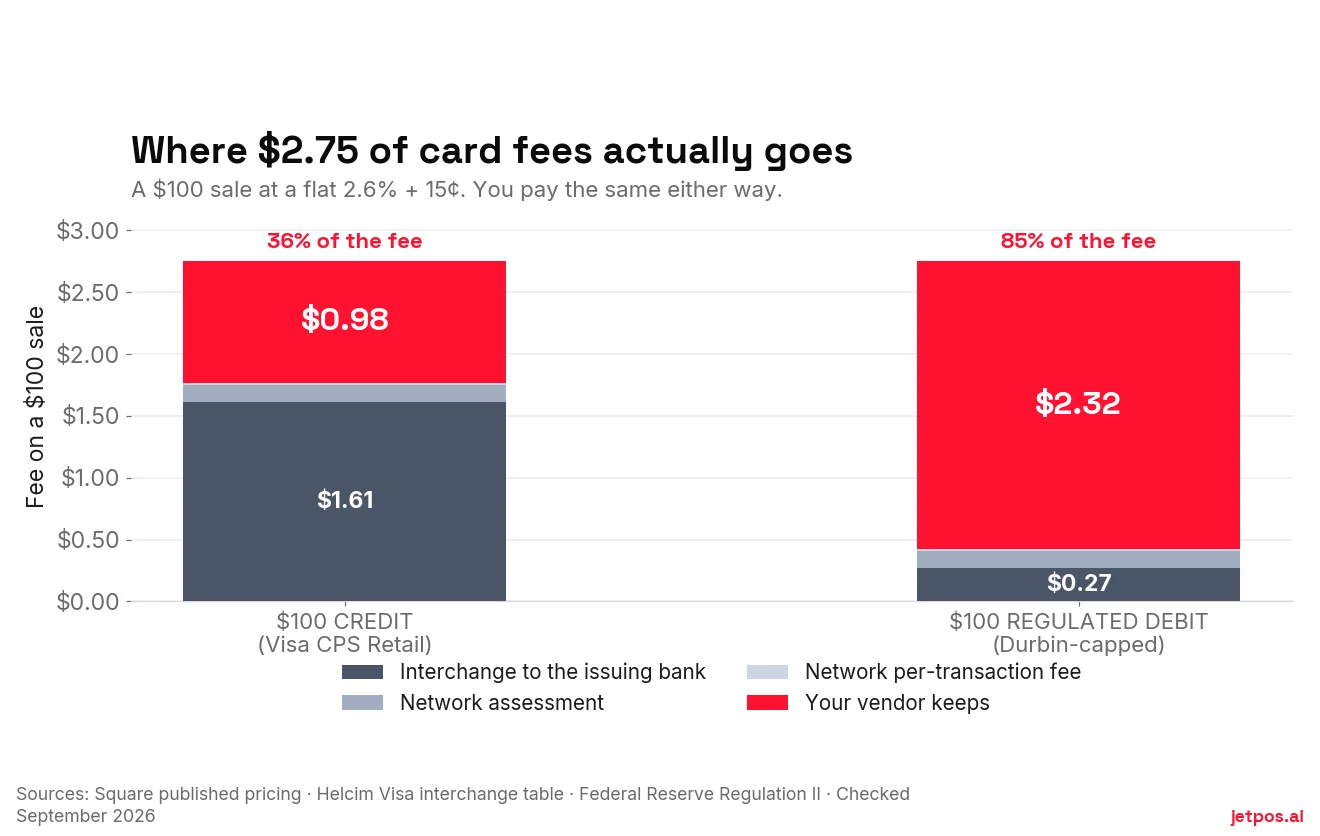
Read that chart once more, because it explains an entire industry.
If your customers pay mostly by debit and your tickets are small — a coffee shop, a convenience store, a takeout counter — you are the most profitable kind of customer a flat-rate processor can have. You are also the one with the most to gain from getting a real rate.
That US debit cap isn't settled law right now. In August 2025 a federal district court held that Regulation II exceeded the Federal Reserve's authority and vacated it — then stayed its own ruling pending appeal. The cap is still in effect today. Watch that appeal if debit is most of your volume.
The fifteen cents nobody notices
Everyone argues about the percentage. The per-transaction cents do the quiet damage.
Fifteen cents is 0.15% of a $100 ticket. It is 0.6% of a $25 ticket. On a $6 coffee it is 2.5% all by itself — bigger than the entire spread between the vendors you are comparing.
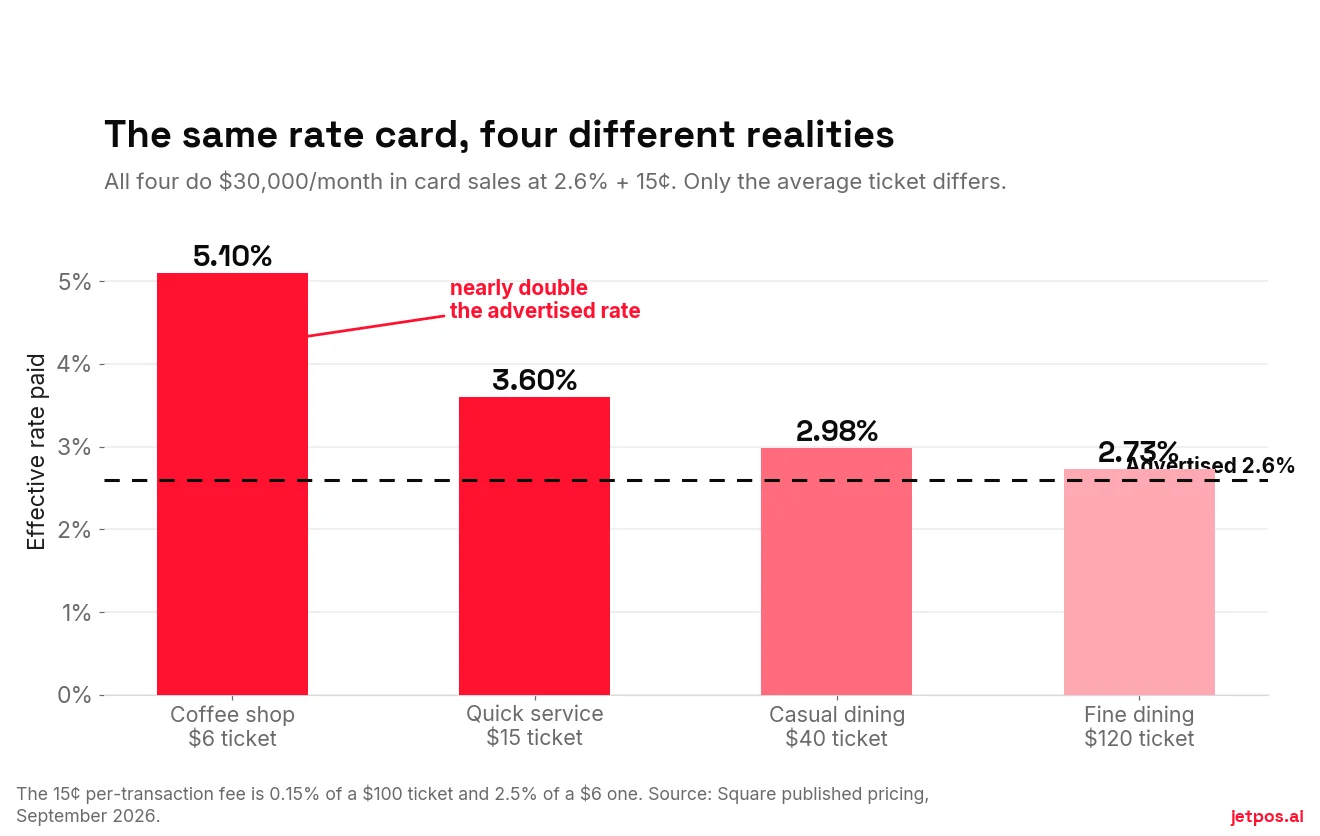
This is also why a rate change you barely notice can be a real increase. In 2025 Square moved its card-present rate from 2.6% + 10¢ to 2.6% + 15¢. The headline percentage never moved.
For that coffee shop doing 5,000 transactions a month, five cents is $250 a month. Three thousand dollars a year, from a change that looks like nothing.
The Toast episode, and what it actually teaches
In June 2023 Toast added a $0.99 order-processing fee to every online order of $10 or more placed through its own digital ordering channels. Diners paid it. Restaurants could not opt out. It was tucked inside an expandable "taxes & fees" line rather than shown on its own.
Operators went public. Letters, posts, competitors piling on. National rollout was July 10; the fee was gone by July 19.
— Chris Comparato, then CEO of Toast, July 2023
That is the part everyone remembers. The part worth learning from came fourteen months later.
In September 2024, Toast raised card processing rates by 0.05% to 0.23% for what it described as a limited portion of its US small and mid-sized customers — and at the same time expanded a surcharging tool that lets restaurants pass card costs to diners in eligible states. Toast's stated reason: it had not raised processing rates in twelve years and that was "no longer sustainable."
Almost nobody protested.
A visible fee on the customer produced a nine-day revolt. An invisible fee on the merchant produced a press release. The cost didn't disappear — the payer and the messenger changed. Which is precisely why the effective rate on your own statement is a better guide to your vendor's behaviour than any announcement.
One correction while we're here, because it's repeated constantly: you'll read that Toast "was hit with a securities class action" over the fee. Several plaintiffs' firms did announce investigations in the weeks afterwards, and those press releases still rank well in search. We checked the Stanford Securities Class Action Clearinghouse, the standard database for these, and could find no docketed securities case against Toast. Investigations are not lawsuits.
For scale: Toast processed $195.1 billion in payments in 2025 and reported $5.04 billion of fintech revenue against $3.89 billion of cost — versus $936 million from software subscriptions. The subscription is not the business. The rate is the business.
Layer 2: the charges that arrive after month three
These are disclosed. They're just disclosed per device and per location, while the price you remember was quoted once.
| Charge | Typical 2026 range | The thing to check |
|---|---|---|
| Software plan | $0–$399 / month per location | Whether "per location" means per address or per register |
| Per-device software | $20–$90 / month each | Kitchen screens, kiosks and handhelds are usually separate line items |
| PCI compliance | $0–$260 / year | Ask what it actually includes — scans? breach coverage? |
| PCI non-compliance | $20–$95 / month | Buys nothing. Stops when you file your questionnaire. |
| Statement fee | $7–$10 / month | Often charged for a PDF |
| Monthly minimum | $5–$25 / month | Charged when your fees fall below a floor |
| Batch / AVS | $0.10–$0.25 / batch, ~$0.10 / AVS | Small, daily, permanent |
| Chargeback fee | $0–$30 per case | Varies wildly — Square charges nothing; others charge on both sides |
Ranges compiled from published processor schedules and Merchant Maverick's fee guides, checked September 2026. Individual contracts vary.
Toast prices a Flex terminal at about $719 and $50 a month. A kitchen display screen at $674 and $35 a month. A kiosk at $1,034 and $90 a month. (Those figures are Merchant Maverick's, from June 2025 — Toast publishes no rates or hardware prices publicly.)
The hardware price is not the hardware cost. Each device also pays rent for as long as it's plugged in.
Layer 3: the add-on menu
Online ordering, third-party delivery integration, loyalty, gift cards, kitchen display software, kiosk software, email marketing, catering, a website. On Toast, published third-party figures put those between $25 and $100 a month each.
Three of them and you have doubled your subscription. This is the layer that turns a $69 quote into a $300 invoice, and it is almost never in the quote because you didn't ask for them yet.
JET's answer to this layer is that there isn't one — the software is included with the hardware, every feature unlocked, $0 a month. But we should be equally clear about what we don't have: there is no kitchen display system in JET. Restaurants route tickets to a kitchen printer instead. If a KDS is a hard requirement for your kitchen, we'd rather you knew that here than found out in week two. We wrote up the honest KDS-versus-printer comparison separately.
Layer 4: the fees that only exist when you leave
Nobody prices these at signing because nobody is thinking about leaving at signing.
Early termination and auto-renewal
A flat ETF runs $200–$600. A liquidated-damages clause is different and much worse: it charges you the remaining term. Cancel a three-year deal after year one and you can owe two years of projected fees.
Auto-renewal is the trap under the trap. The typical clause renews you automatically unless written notice arrives at a specific recipient inside a window 30 to 90 days before the renewal date. Three conditions, each able to fail independently. Miss it and the termination formula applies to a brand-new term. We broke the whole thing down in the guide to POS contracts.
Equipment leases
Sixty dollars a month sounds like nothing against a $1,000 terminal. Over a 48-month non-cancellable lease it is $2,880 — and the lease is frequently with a separate leasing company, so cancelling your processor does not cancel it. Closing the business often doesn't either.
Hardware that can't come with you
A Clover bought through one processor cannot have its payment functions reprogrammed for another. Buy a $1,799 to $4,447 bundle and you have not bought an asset, you have bought a reason to stay. That is the single clearest example of what we call processor lock-in.
The penalty for using your own processor
The newest mechanism, and the least discussed. Your vendor doesn't forbid you from bringing your own processor. It just prices you out of it.
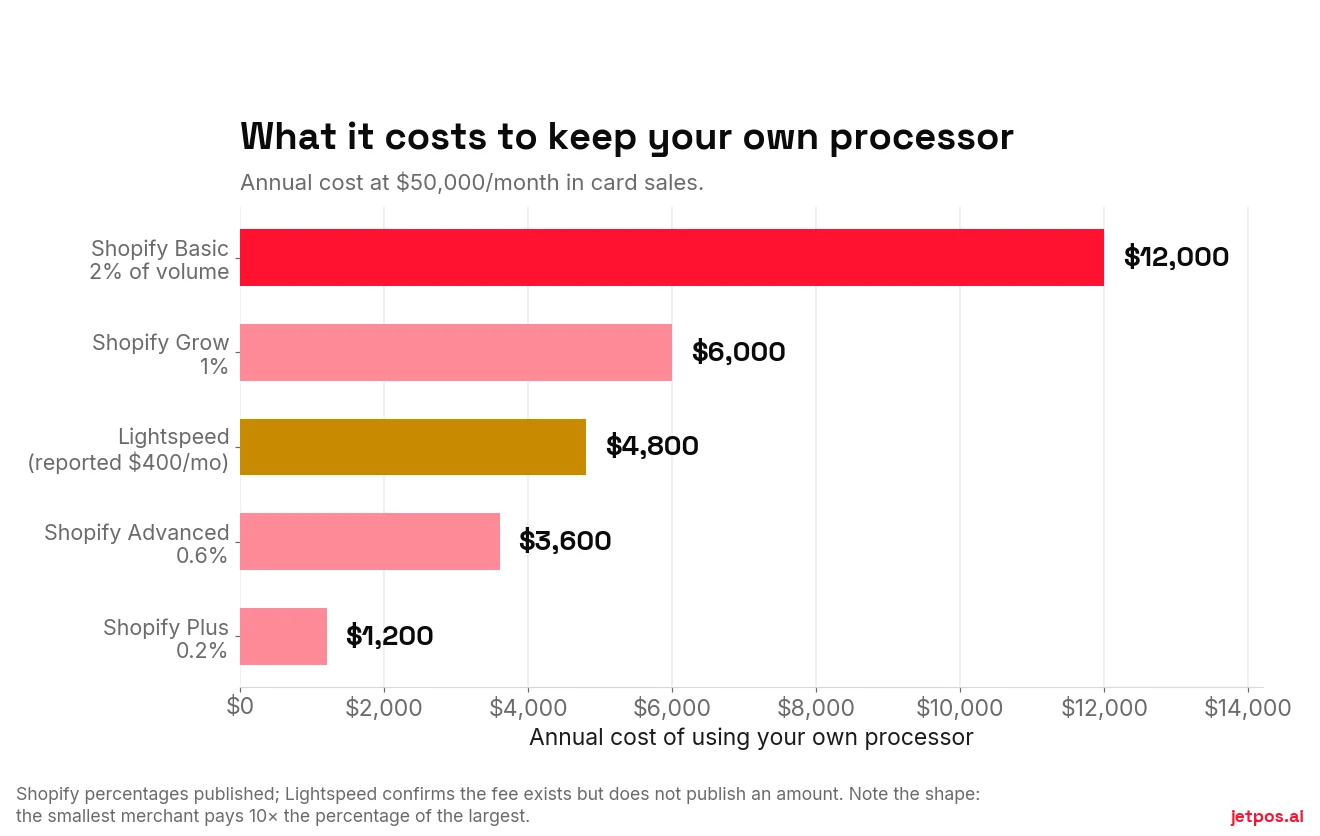
Two things belong beside that chart, in fairness. Lightspeed publicly committed in late 2023 to a "Meet or Beat" promise: if it can't match or beat your existing processing rate, it won't charge the third-party fee and won't require you to move. And in 2023 a bike shop was quoted $69 a month on Lightspeed's unified plan versus $696 a month to keep its own processor — which is the mechanism in the raw.
"Free" is a rate, not a price
Here is the cleanest proof that $0/month software is paid for somewhere, using one vendor's own two tiers.
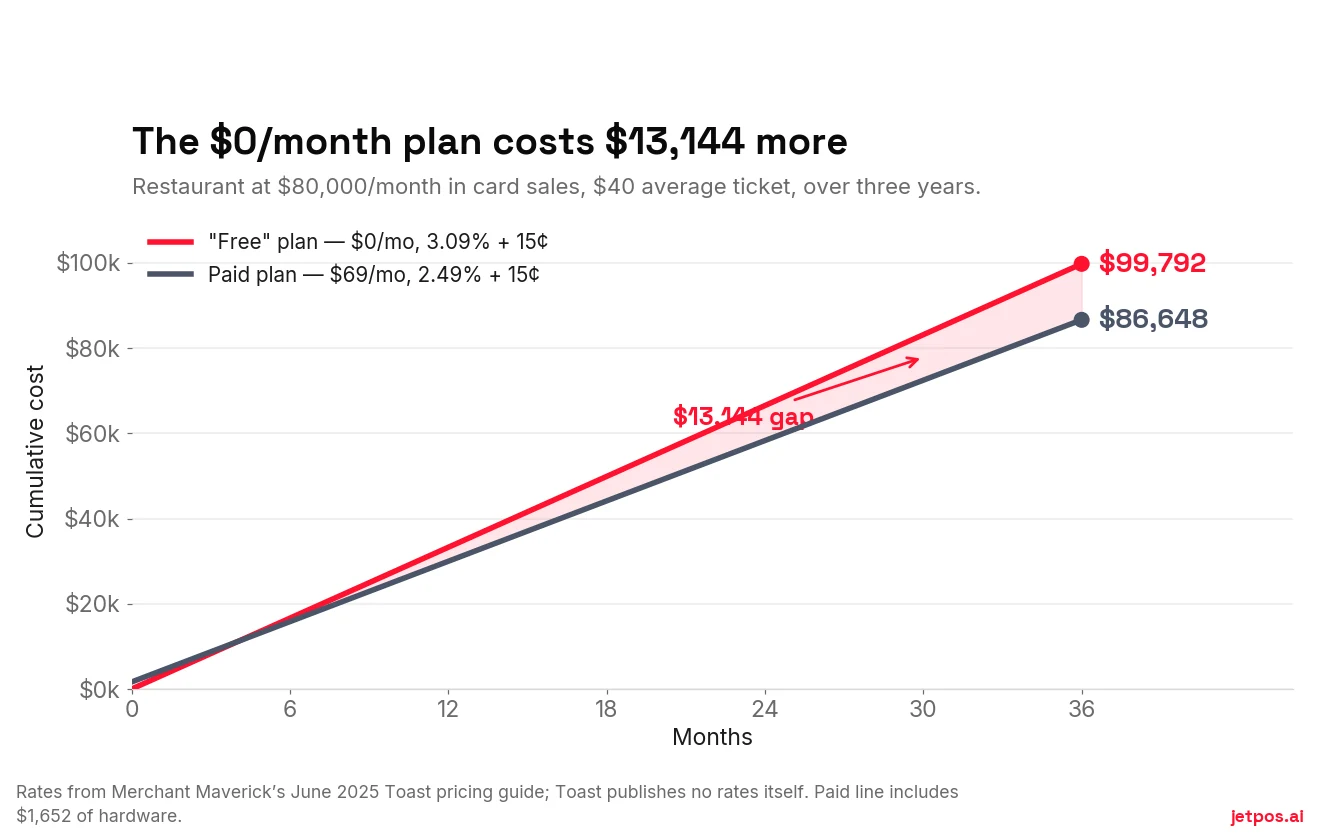
The arithmetic is not subtle. A 0.6% rate difference on $80,000 of monthly volume is $480. The subscription you avoided was $69.
This is not an argument that free plans are bad. It is an argument that free software has a price and the price is in the rate. If you know that going in, a free plan can be exactly right for a low-volume business. If you don't, you'll pick it for the wrong reason.
Ten questions to put in writing before you sign
Say "please confirm in email." Watch which ones get a number and which get a paragraph.
- Flat rate or interchange-plus? If interchange-plus, what's the markup in basis points and cents?
- What is my rate for regulated debit specifically? If they quote one rate for everything, you're on flat, and you're paying the debit spread.
- What's the contract term, and does it auto-renew? How many days' notice, in what format, sent to whom?
- Is the termination fee a number or a formula? Ask to see the formula.
- Is there any fee for using a different payment processor? How much?
- If I leave, can I keep and reuse this hardware? Yes or no.
- Is the hardware bought, financed or leased? If leased, with you or with a third party?
- List every per-device and per-location monthly charge. Every screen, handheld, kiosk, second terminal, second location.
- Is there a PCI fee, a non-compliance fee, a statement fee, a monthly minimum, a batch fee, an annual fee?
- Under what circumstances can you raise my rate, and how much notice do I get?
What to look for on this month's statement
- Your effective rate. Total fees ÷ total card volume. The only number that matters.
- Debit and credit shown separately. If your statement doesn't split them, ask for one that does. A debit effective rate above about 1% means you're paying flat-rate margin on capped cards.
- Transaction count × per-transaction fee. For a low-ticket business this line is often the largest single cost on the page.
- Anything labelled PCI. Compliance fee, or non-compliance penalty? They are not the same thing.
- Downgrade, non-qualified, fallback or EMV categories. If tip adjustments are downgrading transactions, that's a workflow problem worth thousands a year.
- The small recurring lines. Statement, minimum, batch, AVS, annual, "network access," "regulatory." Individually trivial. Together, usually $50–$200 a month.
- Per-device software charges. Count your devices. Count the lines. They should match.
One line for Canadian operators
Since October 2024, Visa transactions under $300,000 a year and Mastercard under $175,000 qualify for a reduced small-business interchange rate — a 0.95% weighted average in store. The federal government estimated more than 90% of card-accepting Canadian businesses qualify.
Interchange is a cost, not a price. On a flat rate, a reduction in the cost doesn't reach you unless your provider passes it on. Ask whether yours did.
What we'd actually do on Monday
Calculate the effective rate. Then get one competing interchange-plus quote using your real statement — not your volume estimate, the actual statement — and compare total cost, not headline rate.
Then read two clauses in your current agreement: the auto-renewal notice window, and the termination formula. Put the notice deadline in your calendar with a 30-day warning. That single calendar entry is worth more than most negotiating.
For the cross-vendor version of this arithmetic, WHICHpos publishes a three-year cost breakdown across nine systems, with its methodology shown on the page.
Disclosure: WHICHpos is published by Solvr Solutions Inc. — the same company that makes JET. It is a sister site, not an independent referee. Read its scoring method and check its figures against the vendors’ own pages before you weigh anything it says about us.