
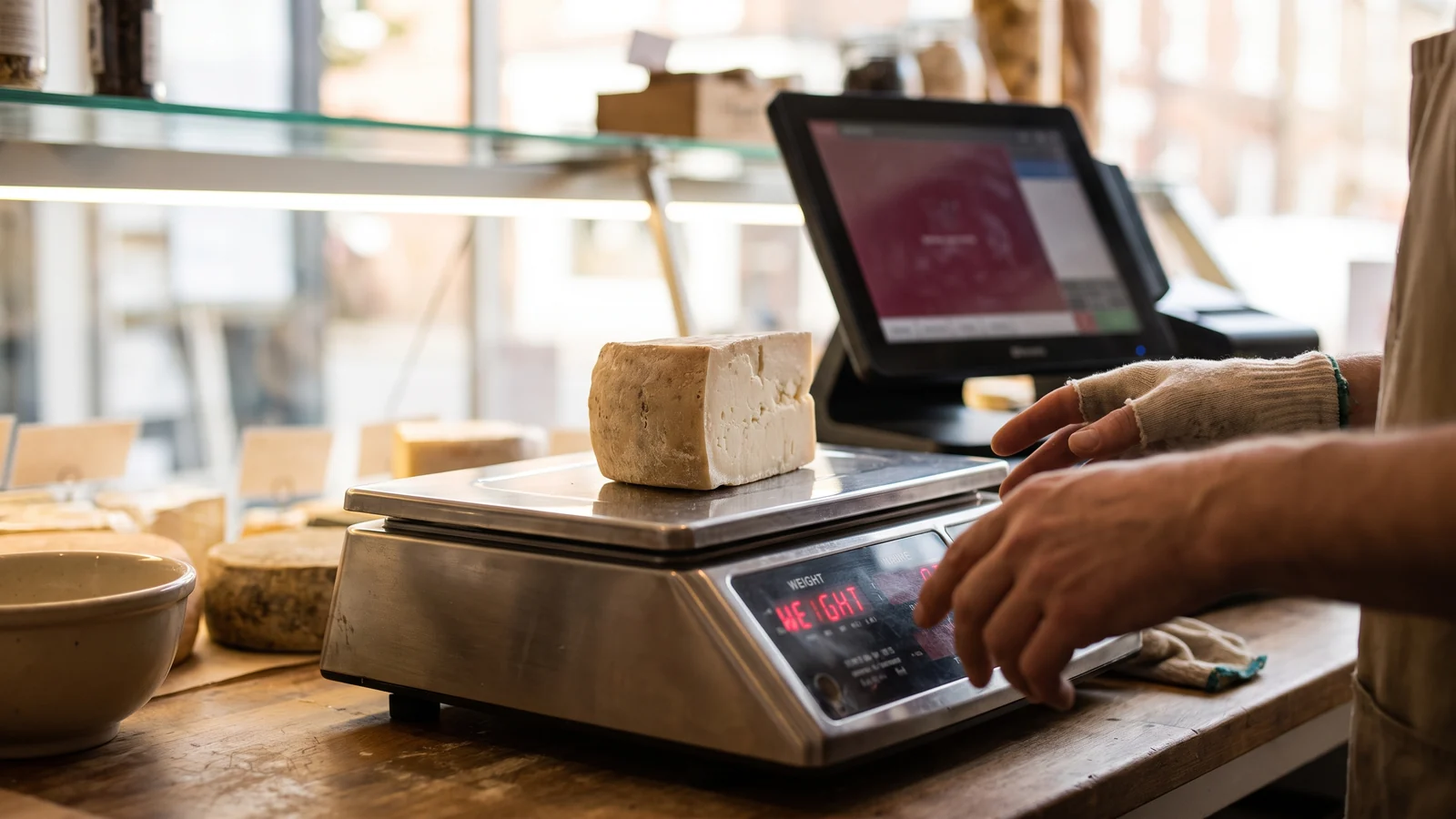
Every scale company's website says an integrated scale "saves time at the counter." None of them tells you how much, and none of them shows the arithmetic.
So here it is, with every assumption printed. Some of it argues against buying one.
The short answer
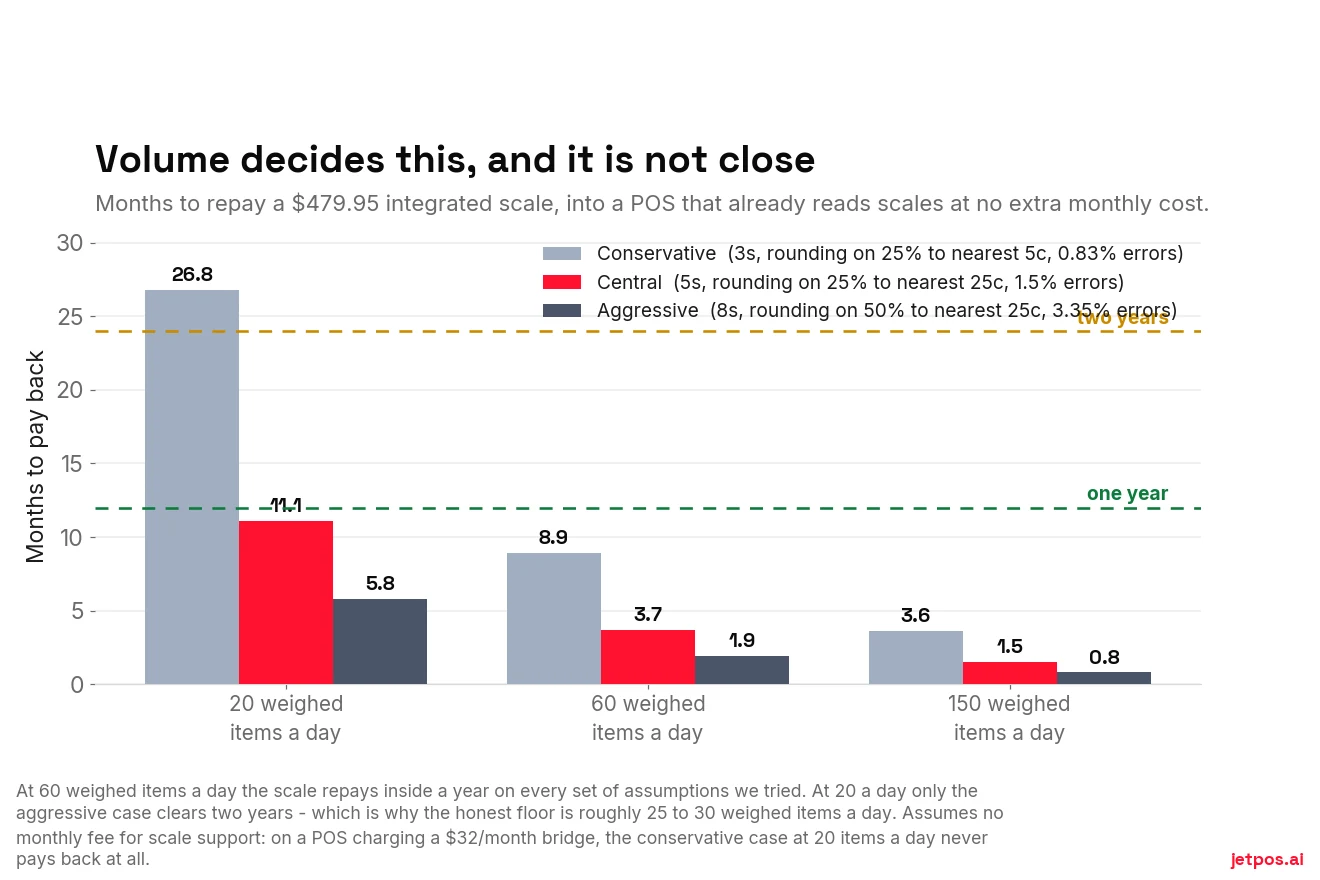
Worth it above roughly 30 weighed sales a day. A legal-for-trade scale that connects to a till runs $480 to $965 once — JET's is $349.95 — and at 60 weighed items a day it pays back in three to five months.
The surprise is where the money comes from. On central assumptions, 44% is staff no longer rounding the price down, 36% is time, 21% is keying errors. Below about 20 weighed items a day it takes over two years, and if you pre-package everything it buys you nothing.
Why one percent matters more than it sounds
Start with the number that makes the rest of this guide land.
The FMS Solutions and National Grocers Association financial survey puts the average independent grocer's net profit before taxes at 2.20% of sales. For the three-quarters of independents who aren't in the top-performing quartile, it's 0.56%.
Work it through. If you make 2.20% net and you give away 1% of the weight, you've lost 45% of the profit on those sales. At 0.56% net, a 1% leak is 178% of the profit — you are now paying for the privilege of selling it.
That ratio doesn't care how big you are. It works the same whether you sell $200 a day of cheese or $2,000.
And the departments where things get weighed are already the leakiest ones you have. The same survey puts total shrink at 3.9% of sales, with deli at 6.8%, bakery at 7.3% and produce at 6.2%.
So where does the money actually come from?
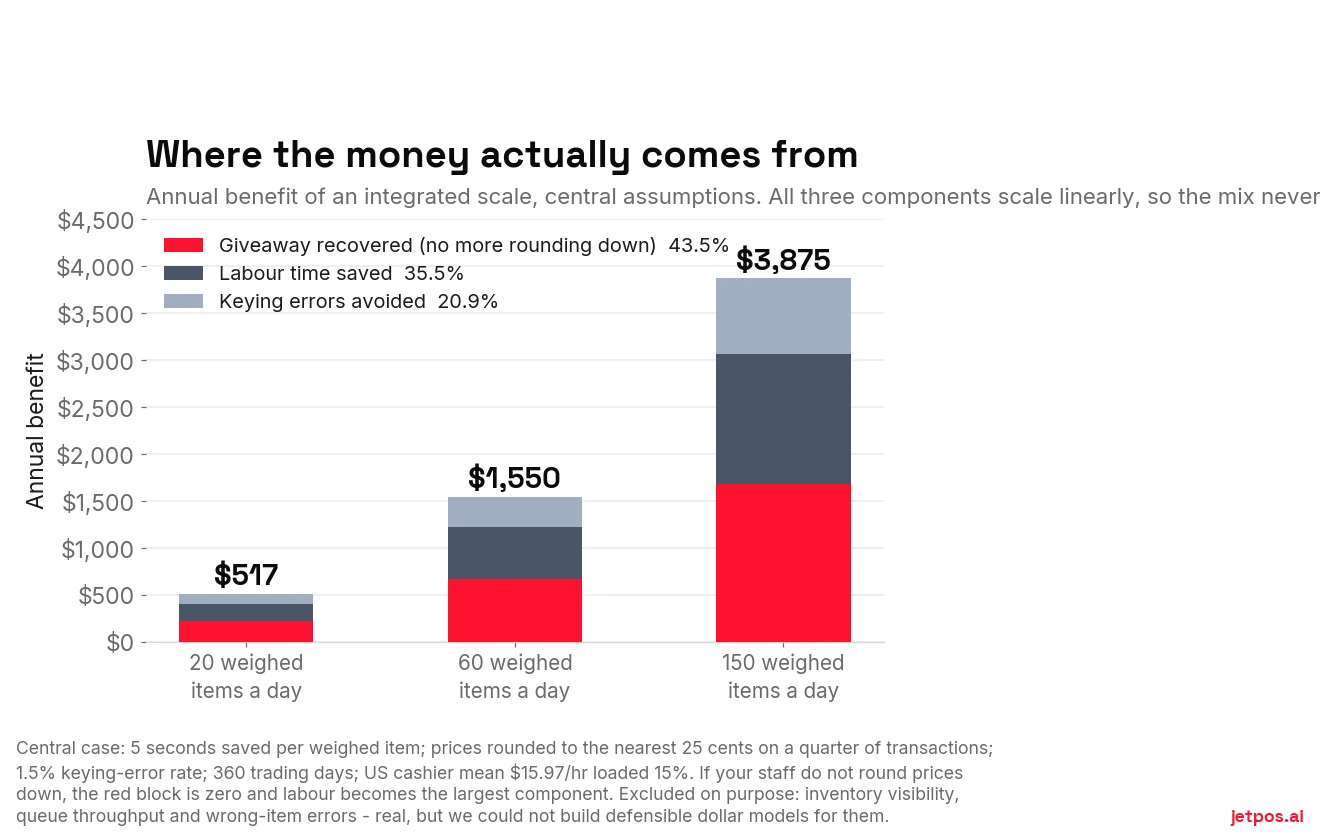
Notice what the chart says and what it doesn't. The three components are recovered giveaway, labour time and keying errors. Nothing else. Saying what isn't in a number is usually more useful than the number.
1. The rounding-down problem — and an honest admission
Here is the part every scale vendor asserts and none of them evidences.
We could not find a single measured figure for weight giveaway in retail. Nine different search strategies across academic, trade, regulator and vendor sources. Every percentage in circulation traces back to a company that sells scales, with no methodology attached. If you see "shops lose 2% to giveaway" quoted anywhere, ask where it came from.
So we modelled the narrow, defensible version instead: rounding down at the keypad. The scale reads 0.47 kg at $12.90/kg. That's $6.063. Someone keys $6.00. It happens on the busy ones, it always rounds the same direction, and it's precisely the behaviour an integrated scale removes — because the till does the multiplication and nobody types anything.
At a quarter of transactions rounded to the nearest 25¢, that's an average of 12.5¢ a sale. At 60 weighed items a day across 360 trading days: $675 a year. That's it. No mystery percentage, just an assumption you can change.
And then the picture changes: labour becomes the largest component at roughly half the benefit, and the total falls by about 44%. We've drawn the chart on the assumption that rounding happens, because in a staffed shop it usually does — but it's an assumption about human behaviour, not a measurement, and you know your own counter better than we do.
This is also why the case is weaker for a one-person shop. You can decide to stop rounding down. You cannot decide it on behalf of four part-timers.
2. The time, and why it's smaller than you'd think
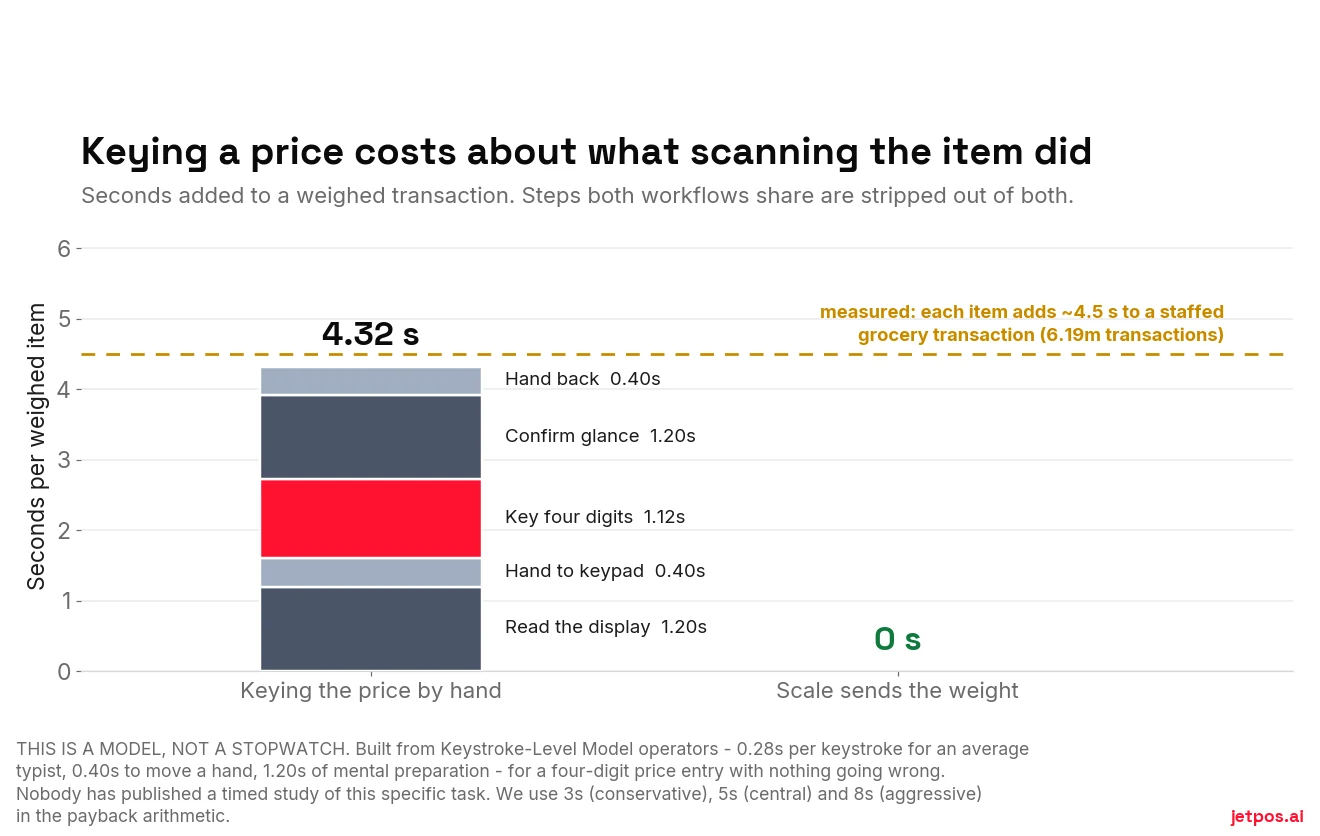
The floor is 4.32 seconds when nothing goes wrong. Read the display, move your hand, key four digits, glance back to check. Nobody has ever published a timed study of this exact task, so treat three to eight seconds as a range rather than a fact — we use five in the central case.
Put next to the reference line, the point sharpens: keying a price by hand costs roughly as much time as scanning the item did in the first place. You're doubling the handling cost of every weighed item.
At 60 weighed items a day and five seconds each, that's 30 hours a year. At the US cashier mean of $15.97 an hour loaded by 15%, about $551.
Automation at the checkout has a mixed record. Grocery labour productivity fell in ten of the thirteen years from 1987 to 2000 — averaging −0.7% a year — and that's the period after barcode scanners became near-universal. Time saved at the counter does not automatically become money unless you actually roster one fewer hour or serve more customers with the same staff. If neither happens, treat the labour column as convenience, not cash.
3. Keying errors, in both directions
People mistype numbers at a measurable rate. A 2019 study in JAMIA compared manual transcription against an automatic interface across 2,992 patients and 60 clinics and found a 3.7% error rate — 3.2% on numeric-only fields, with 14.2% of the errors off by more than 20%.
The retail-specific version is older but directly on point. The FTC and NIST's Price Check II examined 107,096 items across 1,033 stores in 36 states and found 3.35% mispriced at the checkout — one item in thirty. Roughly half undercharges and half overcharges.
That symmetry matters. Undercharging costs you margin. Overcharging costs you a customer, and in some jurisdictions a visit from the weights-and-measures inspector. An integrated scale removes the keystroke that causes both.
The scales themselves drift, and somebody is checking
This is the part most buying guides skip entirely, and it comes from a regulator rather than a vendor.
Colorado's Office of the State Auditor tested scales in the field. 45 of 239 failed inspection — about 19%. Roughly one scale in five, wrong enough to fail.
Their worked example: a single grocery scale over-weighing by 0.29 lb would overcharge customers by $31,755 over a year at 60 customers a day. Read that as the auditor's illustration rather than a universal figure — the published summary doesn't spell out every assumption behind it, and the arithmetic only works at a particular price per pound. But the direction stands, and it runs both ways: a scale reading light is giving your stock away.
The same audit found at least 3,434 licensed devices that went uninspected in a single year across 636 businesses, against a statutory requirement of at least every twelve months. Which is the useful lesson: nobody may come and check for years, and then one day somebody does.
What it costs, and when it pays back
Real prices, checked September 2026:
| Scale | Price | Connects? | Notes |
|---|---|---|---|
| AvaTek PCN10, 10 lb | $96.49 | No data port | Legal for trade, but nothing to plug in — you still key the price |
| JET Integrated Weighing Scale | $349.95 | USB to JET | 0.1–30 kg, stainless platform, one-time |
| Brecknell 6710U, 30 lb | $479.95 | USB + RS-232 | NTEP and Canadian approval; the common workhorse |
| CAS PD-II PD-2ZS30, 30 lb | $661.00 | USB + RS-232 | NTEP CoC 92-174A4 |
| Tor Rey W-LABEL40L, 40 lb | $965.00 | Prints labels | Prepack scale — prints a barcode the till scans, rather than connecting live |
List prices from online retailers, September 2026; street prices through a reseller usually run lower. The point of the first row is that "legal for trade" and "connects to your POS" are two different questions, and the cheap scales answer only the first.
There's a second cost that isn't the scale. Some POS systems charge a monthly fee for the privilege of reading one. Lightspeed's X-Series needs a third-party bridge at $32 a month — $384 a year, $1,152 over three years, which is more than twice the price of the scale itself. At 20 weighed items a day on conservative assumptions that combination never pays back: the benefit is $17.91 a month and the fee is $32. We take that apart properly in the guide to which POS systems actually read a scale.
What this looks like in five kinds of shop
The arithmetic above is generic. Your shop isn't. Here is roughly where each type lands, using the same central assumptions.
| Shop | Weighed items a day | Where the money is | Verdict |
|---|---|---|---|
| Butcher shop / meat market | Nearly every sale | Giveaway. Trimming to a round number is constant, and beef at $6.89/lb makes every rounding-down expensive. | Buy it |
| Deli counter in a grocery | High, and clustered at lunch | Split between giveaway and queue — the counter is the bottleneck for the whole store at noon. | Buy it |
| Bulk foods, candy, nuts, coffee bins | Medium to high | Giveaway and keying errors. Lots of small weights, lots of unit prices, lots of chances to fat-finger. | Buy it |
| Produce shop / greengrocer | High | Speed, mostly. Prices are low per item so a rounding error costs little, but the transaction count is enormous. | Usually |
| Convenience store, bodega, corner store, dépanneur | Often under 20 | Usually not enough to matter — unless you run a deli case or sell loose candy by weight. | Count first |
Same central assumptions as the payback chart: 5 seconds saved per weighed item, prices rounded to the nearest 25¢ on a quarter of transactions, 1.5% keying errors, 360 trading days.
The convenience store case, honestly
This is the one most likely to be sold something it doesn't need, so let's be specific.
A convenience store, bodega or dépanneur that sells packaged goods and nothing else does not need a scale at all, integrated or otherwise. Everything scans. The scale would sit there earning nothing.
The picture changes the moment you add a counter. If you have a hot case, a deli slicer, loose candy, a coffee bar with bulk beans, or you portion anything into containers, count those transactions for a week. Most owners guess high, and the honest number decides it. Above 25 to 30 a day the arithmetic works. Below that, buy a good $100 price-computing scale, stop rounding down, and revisit next year.
The one exception worth naming: if you're already replacing the POS for another reason, the marginal cost of getting scale support built in is zero on a system that includes it — and quite a lot on one that charges monthly for it. That changes the maths, and it's covered in the guide to which POS systems actually read a scale.
The butcher and deli case, honestly
The opposite end. Here almost every sale is weighed, so the volume question answers itself and the giveaway argument does the heavy lifting.
Two things make it worse than the generic model. First, the price per pound is high — US ground beef averaged $6.89/lb and natural cheddar $5.74/lb in mid-2026 — so every rounded-down price gives away more. Second, deli and meat are already the leakiest departments in food retail: 6.8% shrink in deli against 3.9% store-wide.
Against a 2.20% net margin, that combination is why a butcher counter is the clearest buy on this list, and typically the fastest payback.
When it is not worth it
Five cases where the honest answer is don't bother.
- You sell only pre-packaged fixed weights. A cheese shop selling pre-cut 200g wedges with printed prices doesn't weigh at the point of sale. Your scale belongs in the back, printing labels — a different purchase entirely.
- You're a roaster selling bag sizes. 250g, 500g and 1kg are SKUs, not weighed items. Integration buys nothing. An open bulk bin is a different business and does need one.
- One person does every transaction. Rounding down and keying errors are behaviours you can simply decide to stop. The case for integration is strongest exactly where you can't supervise the keypad.
- Weighed sales are a rounding error in your P&L. A dépanneur selling loose candy twice a day will not recover $480 from it. Run the arithmetic with your weighed-item count, not your total transaction count.
- Your POS charges a monthly bridge fee and your volume is low. Add it to the cost side before you decide. Sometimes the sum is negative forever.
Rough floor: below about 25 to 30 weighed items a day, integration doesn't pay back inside two years on conservative assumptions. Above 50, it pays back inside a year on almost any assumption you choose.
At low volume the better advice is unglamorous: buy a good non-connected price-computing scale for around $100, weigh everything properly, stop rounding down, and revisit in a year. That one behaviour change captures most of the benefit for a fifth of the money.
One legal thing you need before you buy anything
In both countries, a scale that decides what a customer pays has to be a government-approved trade device. Accuracy is not the test. Approval is.
United States. The National Type Evaluation Program, run by NCWM, issues a Certificate of Conformance for devices used "in trade or commercial applications" — which it defines to include establishing the cost of something on the basis of a measurement. NIST's own guidance is that "the most important aspect is that the scale has an active NTEP Certificate of Conformance." New York puts it flatly: "All commercially used weighing and measuring devices must be approved prior to use in New York State." Requirements vary by state, so check yours.
Canada. "Only approved devices can be used in measurement-based trade in Canada." And there's a clock on it: retail food is on a five-year mandatory examination cycle — explicitly covering supermarkets, fruit and vegetable stores, candy and nut stores, meat markets and other food specialty stores. Dairy is two years, fishing and forestry one. Penalties run from administrative monetary penalties of $250 to $2,000 per violation up to court fines of $10,000, $25,000 and $50,000 for repeat offences.
What to look for on the plate before you pay:
- US: a Certificate of Conformance number, the accuracy class (I, II, III, III L or IIII — retail counter scales are normally Class III), the manufacturer, model, serial number, and capacity with its division. No CoC number means it is not a trade scale.
- Canada: an approval number marked so it's identifiable as Canadian — "Canadian Approval AM-4145", "MC AM-4145", "CND W&M AM-4145" or "AM-4145" — plus the accuracy class as I, II, III, III HD or IIII. Note III HD, not the American III L.
- Both: clear space on the device for the inspector's verification marks, at least 1.3 × 2.5 cm in Canada.
This is why the second-hand scale on Marketplace with a blank plate is worth nothing: you cannot get it sealed. And it's a real constraint on the cheap end of the market — plenty of $40 platform scales weigh accurately and are still illegal to price a sale with.
The three questions that actually decide it
- How many things do you weigh in a day? Under 25, probably not. Over 50, probably yes. Count for one week before you decide anything — most owners guess high.
- Does anyone round the price down? Watch the counter for an afternoon. If it happens, that's the money, and it's bigger than the time saving at every volume we modelled.
- Does your POS read a scale without an extra monthly fee? If it charges $32 a month, add $384 a year to the cost side. If it can't do it at all, you're not deciding about a scale any more — you're deciding about a POS.
What we'd do on Monday
Put a tally sheet by the scale and count weighed sales for a week. Multiply by the numbers above with your own average ticket. Then ask your POS vendor one question in writing: which exact scale models do you support, and does it require a paid plan or add-on?
That single question separates the systems that genuinely support scales from the ones that say they do.
For a side-by-side of who publishes what, WHICHpos compares no-monthly-fee systems with its scoring method published.
Disclosure: WHICHpos is published by Solvr Solutions Inc. — the same company that makes JET. It is a sister site, not an independent referee. Read its scoring method and check its figures against the vendors’ own pages before you weigh anything it says about us.