

About 35% of US small businesses now add a credit card surcharge, according to J.D. Power's 2026 merchant services study of 4,407 small-business customers.
Most of them are not doing it entirely correctly, and a smaller number are doing it in a jurisdiction where they can't do it at all.
This is the most rule-bound topic in payments, and the published guidance on it is unusually bad — while researching this we found a widely-cited guide attributing the debit surcharge ban to a statute that is actually the Military Lending Act. So everything below is anchored to the statute or the network document that says it.
Surcharging law is state by state and it moves. Kansas flipped from a ban to a disclosure rule effective January 2025; New York rewrote its rule in February 2024. We researched this in September 2026 and we did not audit every state's 2025 and 2026 legislative sessions. Confirm your own jurisdiction, and talk to your acquirer, before you switch anything on.
The short answer
Usually yes. In most of the US, and in Canada outside Quebec, you may add a credit card surcharge — but only within strict limits: never on debit or prepaid, never above your actual cost of acceptance, capped at 3% (Visa US), 4% (Mastercard US) or 2.4% (Canada), after 30 days' written notice to your acquirer, with signage at the door and the till and a separate line on every receipt.
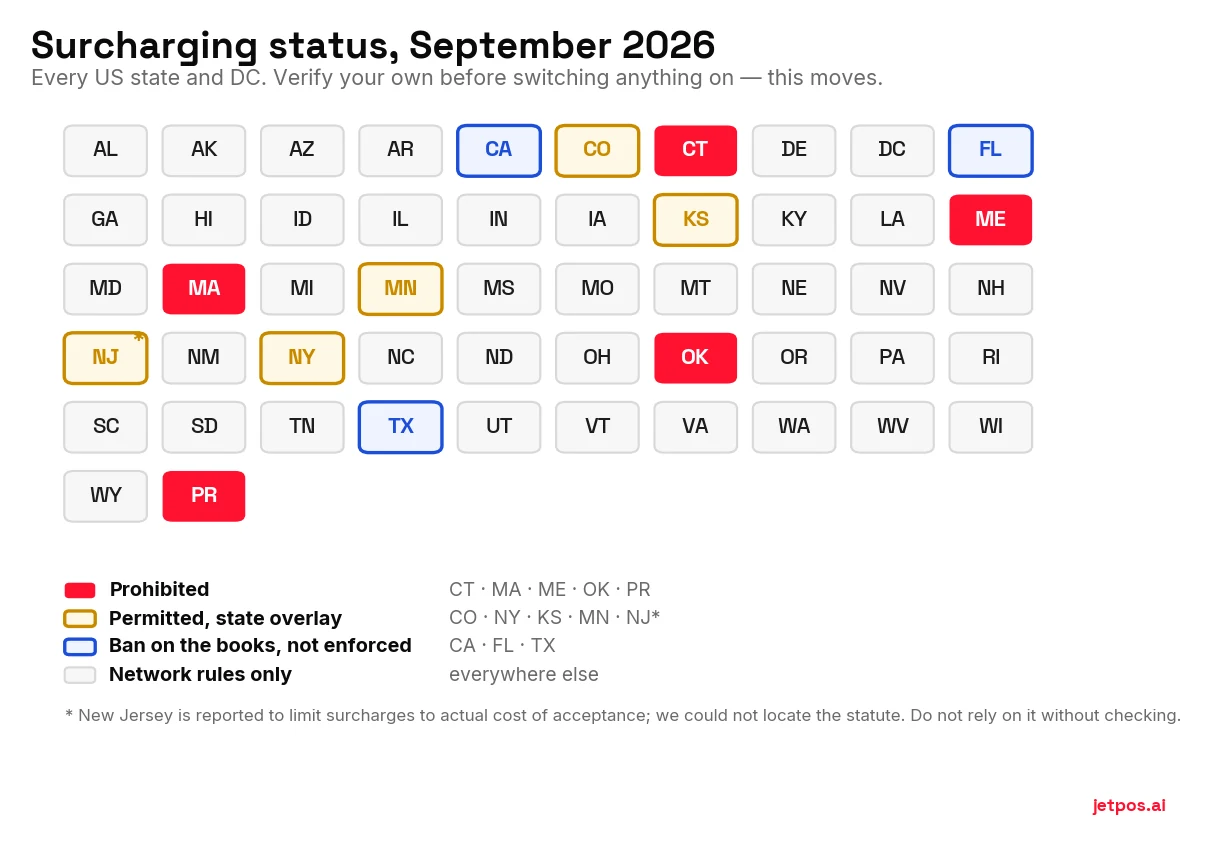
Connecticut, Massachusetts, Maine, Oklahoma and Puerto Rico prohibit it. A cash discount is a legally different — and federally protected — thing, and in five states it's the only version available to you.
Three practices, three different legal characters
Surcharging, cash discounting and dual pricing are constantly treated as synonyms. They are not. The difference is which price is the posted price — not the arithmetic, because the card customer can end up paying the same amount in all three.
| Surcharging | Cash discounting | Dual pricing | |
|---|---|---|---|
| What's posted | One price — the lower, cash price | One price — the higher price everyone pays unless they qualify | Two prices, both shown |
| At the till | An amount is added for credit | An amount comes off for cash or debit | Customer pays whichever matches their tender |
| Legal character | A regulated fee — state law plus network rules | A discount — federally protected | A presentation of discounting |
| 30-day notice / registration | Required | Not required | Not required |
| Cap | 3% / 4% US, 2.4% Canada, ≤ cost | No network cap | No network cap |
| Works in CT, MA, ME, OK, PR? | No | Yes | Yes |
| Cost to implement | One config flag | Reprice everything upward | Reprice and display two numbers |
| How customers read it | A penalty at the end | A reward | Transparent, chosen upfront |
The federal position on discounts is worth knowing because it's stronger than most merchants realise. Under 15 U.S.C. § 1666f, a card issuer may not, by contract or otherwise, prohibit a seller from offering a discount to induce payment by cash or cheque. And a properly disclosed cash discount isn't a finance charge, provided it's offered to all buyers and disclosed clearly.
Adding a "3% non-cash adjustment" line on top of your existing menu prices and calling it a discount does not make it one. The industry test is behavioural, and a compliance specialist put it plainly in Digital Transactions this year: "If you're adding a fee at any point in time, it's a surcharging programme."
For it to be a genuine discount, the posted price has to actually be the higher price. That means repricing your menu, your shelf tags, your website and your third-party listings — which is why so many "cash discount" programmes quietly aren't.
The rules that apply everywhere, whatever your state says
These come from Visa and Mastercard, and they bind regardless of jurisdiction. Get any one wrong and your acquirer can be fined — Visa's documentation specifies an immediate $1,000 assessment against the acquirer of a merchant found surcharging improperly, and acquirers pass that on.
- Credit only. Debit and prepaid can never be surcharged — including when a customer runs a debit card as "credit."
- Never above your cost of acceptance. Visa's cap is the lower of your merchant discount rate or 3%. Mastercard's headline cap is 4%; at brand level it's the lesser of 4% and your average effective merchant discount rate for Mastercard credit, and at product level it must not exceed your cost to accept that specific Mastercard credit product minus the Durbin cap on debit interchange. In practice the level-playing-field rule below pulls all of it down to 3%.
- Thirty days' written notice. To your acquirer for Visa; to both Mastercard and your acquirer for Mastercard. Registration asks for your locations, your channel, and whether you're surcharging at brand or product level.
- Brand level or product level. Not both.
- The level playing field rule. You generally must surcharge Visa on the same terms as any equal or higher-cost competing brand. This is why Mastercard's 4% ceiling is theoretical — you can't charge more for Mastercard than for a competitor capped at 3%.
- Signage in three places: point of entry, point of sale, and every receipt.
- Itemised separately on the receipt, and carried in a dedicated field in the transaction message.
Where you can't do it
Prohibited
Connecticut, Massachusetts, Maine, Oklahoma and Puerto Rico. That's the list Visa itself publishes to merchants.
Two details matter. Connecticut's statute is unusually broad — "no person may impose a surcharge on any transaction," not just credit. And Maine and Oklahoma both ban surcharges on debit as well as credit by statute.
All five expressly permit cash discounts. That's your route in those states, and it's a real one.
Some 2026 guides have dropped Oklahoma from the prohibited list and state it "caps surcharges at 2%." We could not find any support for that in the statute, which still reads as a ban and was last amended in 2019. It looks like a mix-up with Colorado's 2% election. Treat Oklahoma as a ban state.
Permitted, with a state overlay
| State | The rule | Since |
|---|---|---|
| Colorado | Elect either a cap of 2% or your actual merchant discount fee — each with its own statutorily prescribed notice. One surcharge per transaction, separate line on the receipt. | July 2022 |
| New York | You must post the total credit-card price, or both prices side by side. The final price can't exceed the posted price. Up to $500 per violation, enforced locally. | February 2024 |
| Kansas | Flipped from a ban to permission. Allowed with clear and conspicuous notice at the point of entry or sale, in advance. | January 2025 |
| Minnesota | Statutory cap of 5%, with oral notice in person or by phone plus conspicuous signage. Network caps bind lower. | Amended 2023 |
| New Jersey unverified | Two independent secondary sources report a 2023 statute limiting surcharges to actual cost of acceptance with disclosure, and they agree on the substance. We could not locate the statute or its public-law citation. Don't rely on this one without checking with a New Jersey lawyer or your acquirer. | Reported 2023 |
Bans still on the books, not enforced
California, Florida and Texas all still have surcharge prohibitions in their statutes. All three have been through constitutional litigation, and Visa no longer lists any of them as restricted.
One nuance worth understanding, because it's routinely reported wrong: California's ban (Civil Code § 1748.1, on the books since 1985) was held unconstitutional in Italian Colors Restaurant v. Becerra in January 2018 — but as applied to the plaintiffs in that case. The Ninth Circuit expressly narrowed its relief to those parties. The statute isn't facially void, and a business that wasn't a party has no injunction of its own. In practice California is widely surcharged and Visa dropped it from the restricted list in 2023. Legally it's a thinner reed than most guides suggest.
And there's a second California exposure that has nothing to do with § 1748.1. SB 478, in force since July 2024, is a pricing-disclosure law: the price you advertise must be the price the customer pays, excluding only taxes and shipping. Guides routinely conflate the two and report "California banned surcharging in July 2024," which is wrong about both statutes. If you surcharge in California, the SB 478 question — whether your posted price has to include the surcharge — is the one to put to a lawyer.
Texas is a split case: the credit surcharge ban isn't enforced, but the debit ban remains live — and network rules prohibit surcharging debit anyway.
Several widely-shared guides assert cost-of-acceptance rules in Nevada, South Dakota, Georgia and Nebraska. We looked for statutory support and found none. We're not saying those claims are wrong — we're saying nobody publishing them cites a statute, so don't rely on them.
We also could not locate an authoritative answer on whether a surcharge is itself subject to sales tax. Treatment appears to vary. Ask your state revenue department or Revenu Québec rather than trusting anyone's blog, including this one.
Canada
Surcharging became permissible on 6 October 2022 as a result of the settlement of the Canadian merchant class actions. That means the rules here are network rules, not a statute — there is no federal Canadian surcharging law.
- Cap: 2.4%, or your average merchant discount rate, whichever is lower. Both networks.
- Thirty days' written notice — to your acquirer for Visa, to both Mastercard and your acquirer for Mastercard.
- Debit and prepaid: prohibited. Interac's own rules bar surcharging Interac debit, and the Visa and Mastercard rules bar it on their debit and prepaid products — so in practice no debit transaction in Canada may be surcharged.
- Disclosure at the point of entry and the point of transaction, and the point-of-transaction notice must state the exact amount or percentage and say that the surcharge is being applied by the merchant, not by the card network, and applies only to credit.
- Quebec: prohibited. The Consumer Protection Act does not allow it, and the same guidance indicates it also blocks adding a debit fee.
The settlement changes this, but not yet
Visa and Mastercard entered an amended settlement agreement in November 2025 covering the injunctive-relief claims, and a judge granted preliminary approval on 9 June 2026. Plaintiffs moved for final approval on 15 July 2026.
As of September 2026, final approval has not been granted — that's from Visa's own quarterly SEC filing, which is the most reliable place to check the status.
The deal would permit surcharges of up to 3% and allow merchants to decline whole card categories. Neither of those things is in effect yet, and major merchant groups have signalled an appeal. Don't restructure your pricing around it.
The arithmetic: is it worth it?
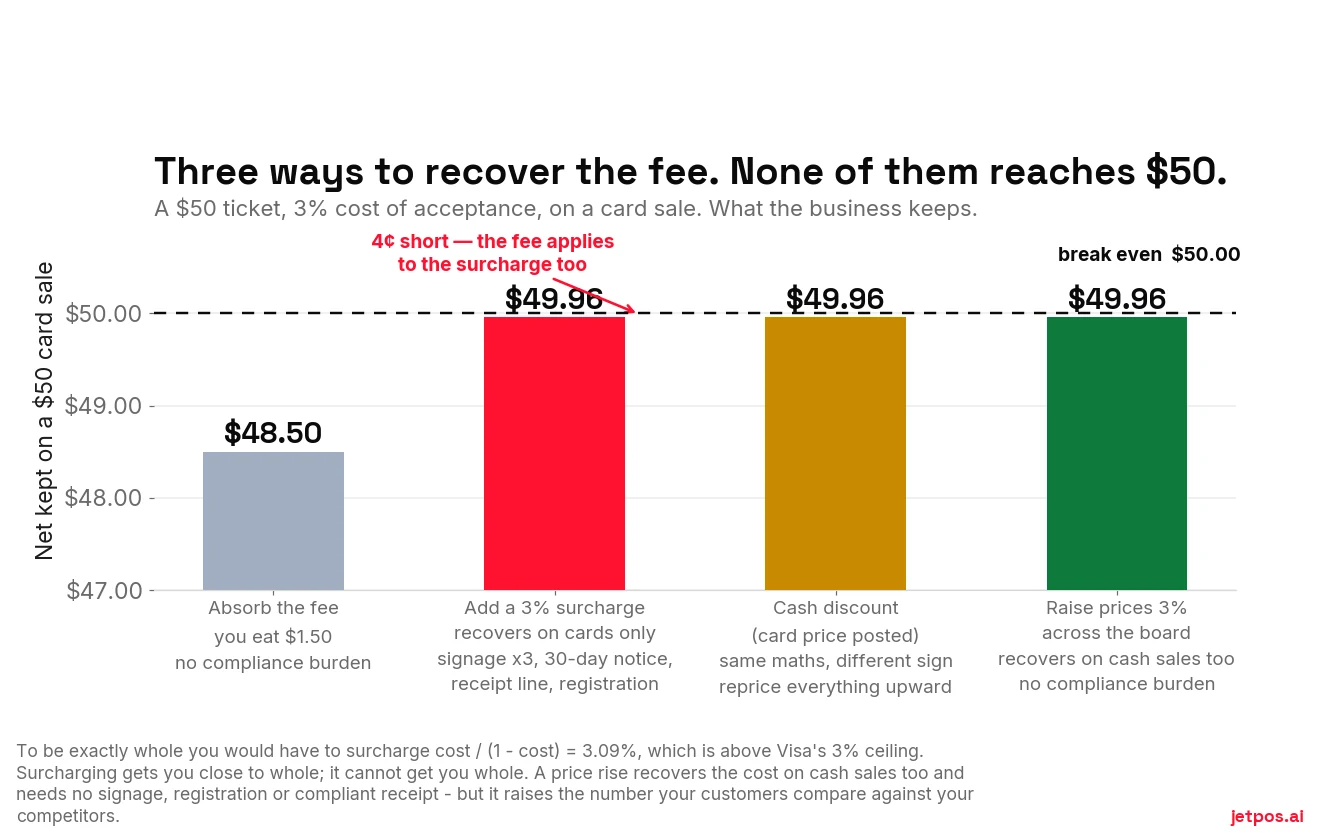
Here's a $50 ticket at a 3% cost of acceptance, four ways. Before the chart, the detail that trips up almost everyone:
Add 3% to a $50 ticket and the customer pays $51.50. Your processor then takes its percentage of $51.50, not of $50 — because the surcharge is part of the transaction. That's $1.545, so you keep $49.96, not $50.00.
Four cents on a $50 sale sounds like nothing. At $600,000 a year in surcharged card volume it's about $540. To be exactly whole you'd need to surcharge cost ÷ (1 − cost), which at a 3% cost is 3.09% — and that is above Visa's 3% ceiling, so you cannot legally get there. Surcharging can get you close to whole. It cannot get you whole. Anyone who tells you otherwise is selling a surcharging programme.
Then there's the part the arithmetic misses.
J.D. Power's 2026 study found 32% of merchants reporting that customers occasionally or frequently abandon purchases when a surcharge is added. Its 2025 study found 41% of credit card users had decided not to use a card at a business because of a surcharge.
And the finding that should give any operator pause: merchants who surcharge report satisfaction with their overall payment-processing costs 24 points lower on a 1,000-point scale than merchants who don't.
That's not what you'd expect if surcharging were solving the problem. The most likely reading is that merchants who surcharge are the ones whose costs were unbearable to begin with — which points at a different fix.
A merchant on a flat rate paying 2.9% who could be paying 2.3% on interchange-plus has a pricing problem, not a customer problem. Surcharging that gap makes your customers pay for your processor's margin. Renegotiating removes it entirely, and nobody has to see a sign.
If you decide to do it
- Confirm your state. Not from a blog — from your acquirer, who has compliance staff and a reason to get it right, and ideally from the statute.
- Work out your real cost of acceptance. Total fees ÷ total card volume. Your surcharge can never exceed it, and if you set it at a flat 3% while your actual cost is 2.4%, you're out of compliance on every transaction.
- Give 30 days' written notice to your acquirer, and to Mastercard directly for Mastercard. Decide brand level or product level. You can't do both.
- Check your POS and terminal can identify card type at payment. The system must distinguish credit from debit by BIN before applying anything, because debit can never be surcharged. This is a terminal and processor capability more than a POS one — ask your acquirer first, and get the answer in writing.
- Verify the receipt. Run a live transaction and look at the printed receipt. The surcharge must appear as its own itemised line.
- Put up all three signs — entrance, till, and on your website if you sell online. Update menus, shelf tags and third-party listings.
- Train staff to say it out loud before the customer commits. Every complaint in this category starts with someone finding out at the terminal.
- Review after 60 days. Basket size, transaction count, card mix, and the reviews. If credit volume shifted to debit, that's the programme working. If footfall dropped, that's it working against you.
Where JET sits
We don't take a percentage of your card sales, so we make exactly the same amount whether you surcharge, discount, or absorb the fee. That's an unusual position to write this from, and it's the reason we'd rather point you at your acquirer than sell you a programme.
One practical note on our own software, stated narrowly: JET can attach a fixed per-item fee to a product — the same mechanism used for an eco fee or a bottle deposit. That is not a card surcharge and shouldn't be used as one, because a compliant surcharge has to be calculated on the card type at the moment of payment, appear in a dedicated transaction field, and print as its own receipt line. Those are terminal and processor functions. If surcharging matters to you, that conversation starts with your acquirer.
What we'd do on Monday
Calculate your effective rate — total fees divided by total card volume — before doing anything else. That number is both the ceiling on any surcharge you could legally charge and the evidence you'd take to a competing processor.
Then get one interchange-plus quote based on your real statement. If it lands materially below your current effective rate, you've solved the problem without a single sign, a registration form, or a customer noticing anything at all.
If it doesn't, and you're in a state that permits it, surcharge properly — and read the rules above rather than trusting the salesperson who's selling you the programme. For the underlying fee mechanics, WHICHpos explains card processing fees line by line.
Disclosure: WHICHpos is published by Solvr Solutions Inc. — the same company that makes JET. It is a sister site, not an independent referee. Read its scoring method and check its figures against the vendors’ own pages before you weigh anything it says about us.