
Your bank stopped sending pennies. A customer's total is $4.33, and there's nothing in the first cup of the drawer.
Do you round up? Down? Is either one legal where you are? And why did the card customer ahead of them pay $4.33 to the cent?
Everything below is sourced with a link, almost all of it to the bill, the statute or the official guidance itself. The arithmetic is ours, and we show it.
The short answer
Round only cash payments, and only the final total after tax, to the nearest 5¢. Totals ending in 1, 2, 6 or 7 round down; 3, 4, 8 or 9 round up; 0 and 5 stay put. Card, tap, check and EBT payments should stay exact to the cent.
Done that way, it costs you nothing. One sale moves at most 2¢ (tiny 1¢ and 2¢ totals aside), and across a normal day the ups and downs cancel. Two exceptions, an item you sell alone over and over and tax-free items priced at .99, are fixed with a price change.
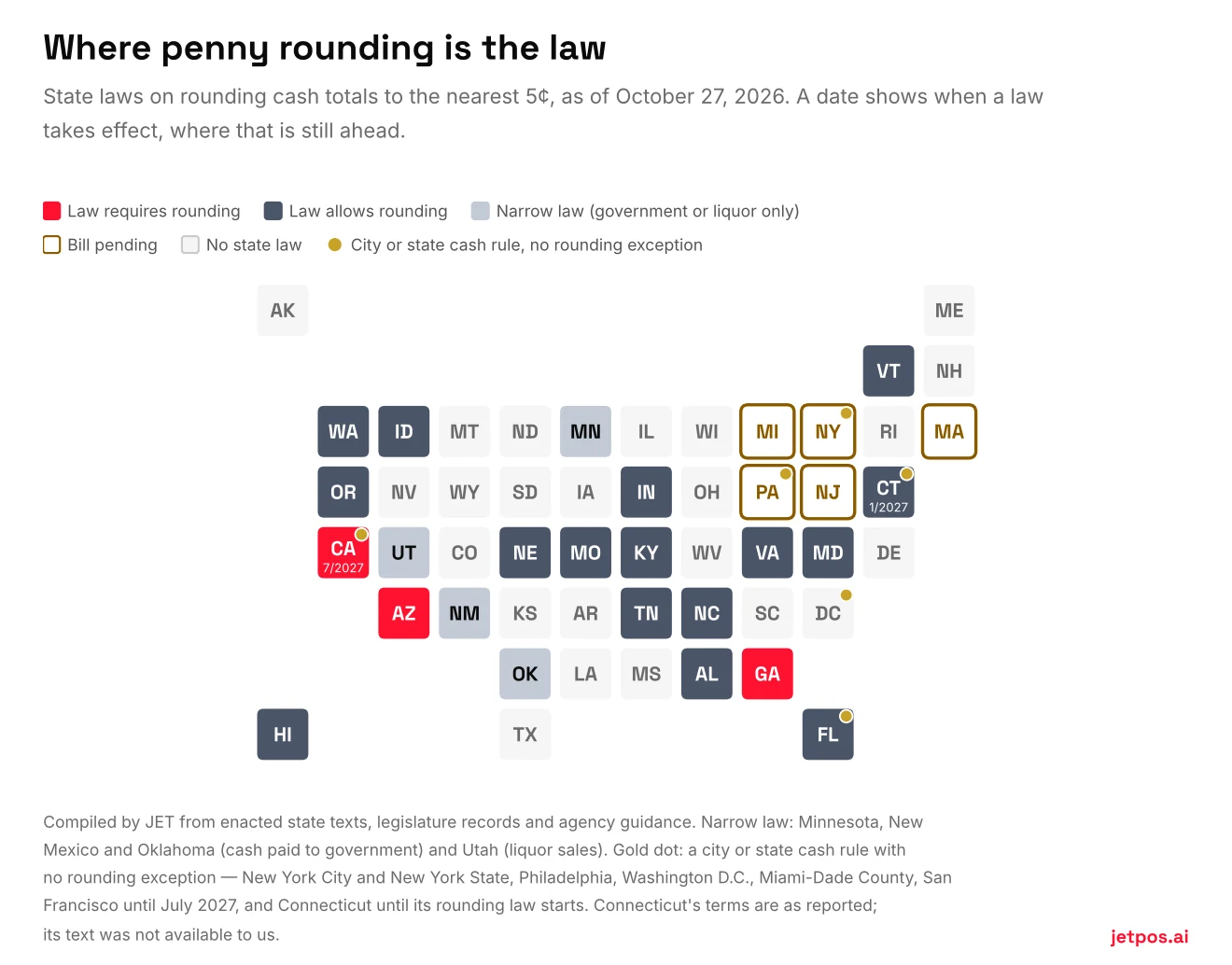
Whether you must round depends on your state. The federal Common Cents Act, passed by Congress in September 2026, lets businesses round cash totals but doesn't require it, and as of October 28, 2026 it had not been signed into law. Seventeen states have rounding laws in force for private businesses; only Arizona and Georgia require it, and California joins them in July 2027. Where a city or state bans charging cash customers more, such as New York City and Philadelphia, rounding up is the risk: round down until a rounding law covers you.
What happened to the penny, and why stores are short
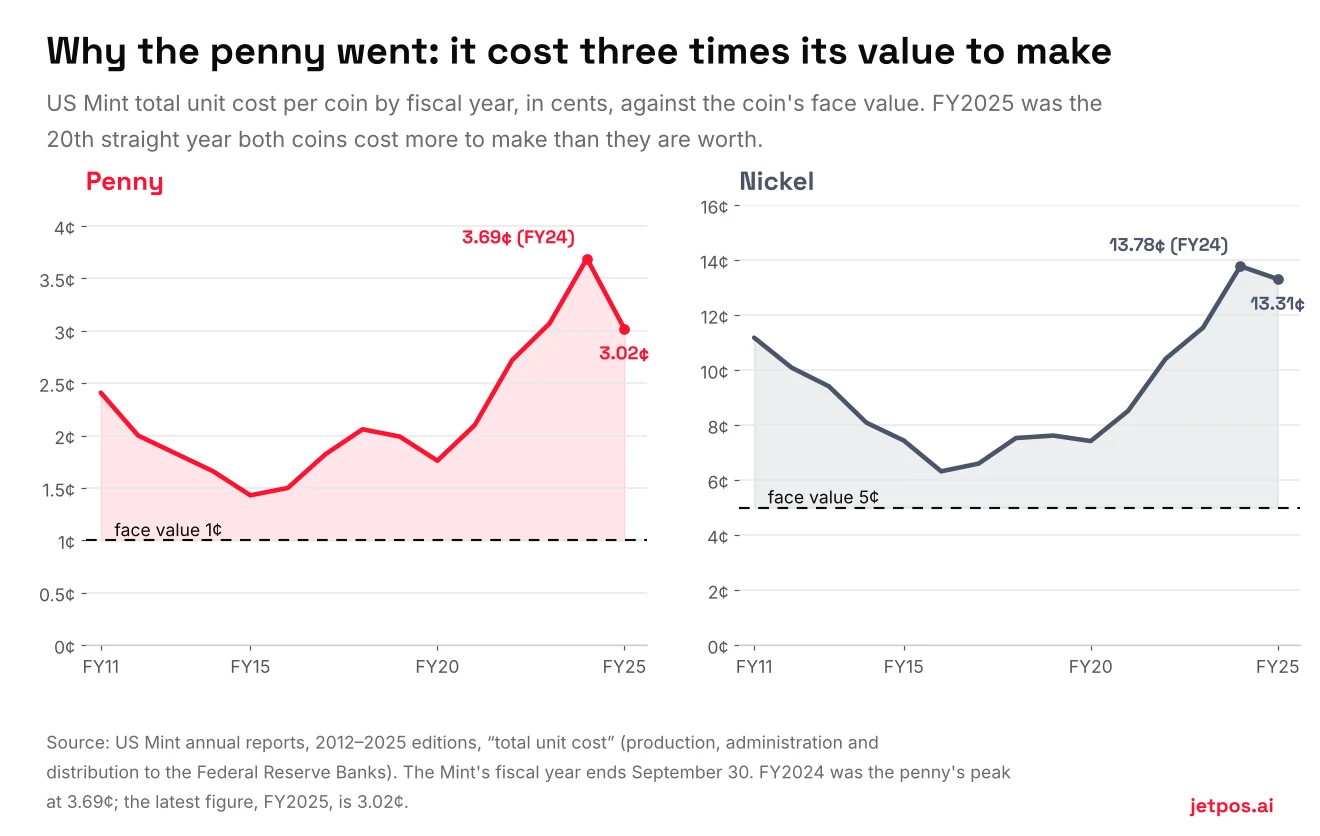
The US Mint struck its final circulating pennies in Philadelphia on November 12, 2025. The reason was arithmetic: a penny cost 3.69¢ to make in fiscal 2024 and 3.02¢ in fiscal 2025, the 20th straight year it cost more than it was worth. Treasury puts the savings at $56 million a year.
Pennies are still legal tender, and billions of them sit in jars and drawers. The problem is getting them back to the till. Between August and December 2025, the coin terminals that fill banks' orders stopped shipping pennies as their stock ran out. The Federal Reserve resumed taking penny deposits from banks on January 14, 2026, and some terminals began filling penny orders again in March, but supply is patchy.
So shops round. The only questions are how, and whether your state has already decided for you.
The penny rounding chart: what rounds up and down
The standard rule is the one Canada adopted in 2013 and nearly every US state law uses: round the cash total to the nearest five cents.
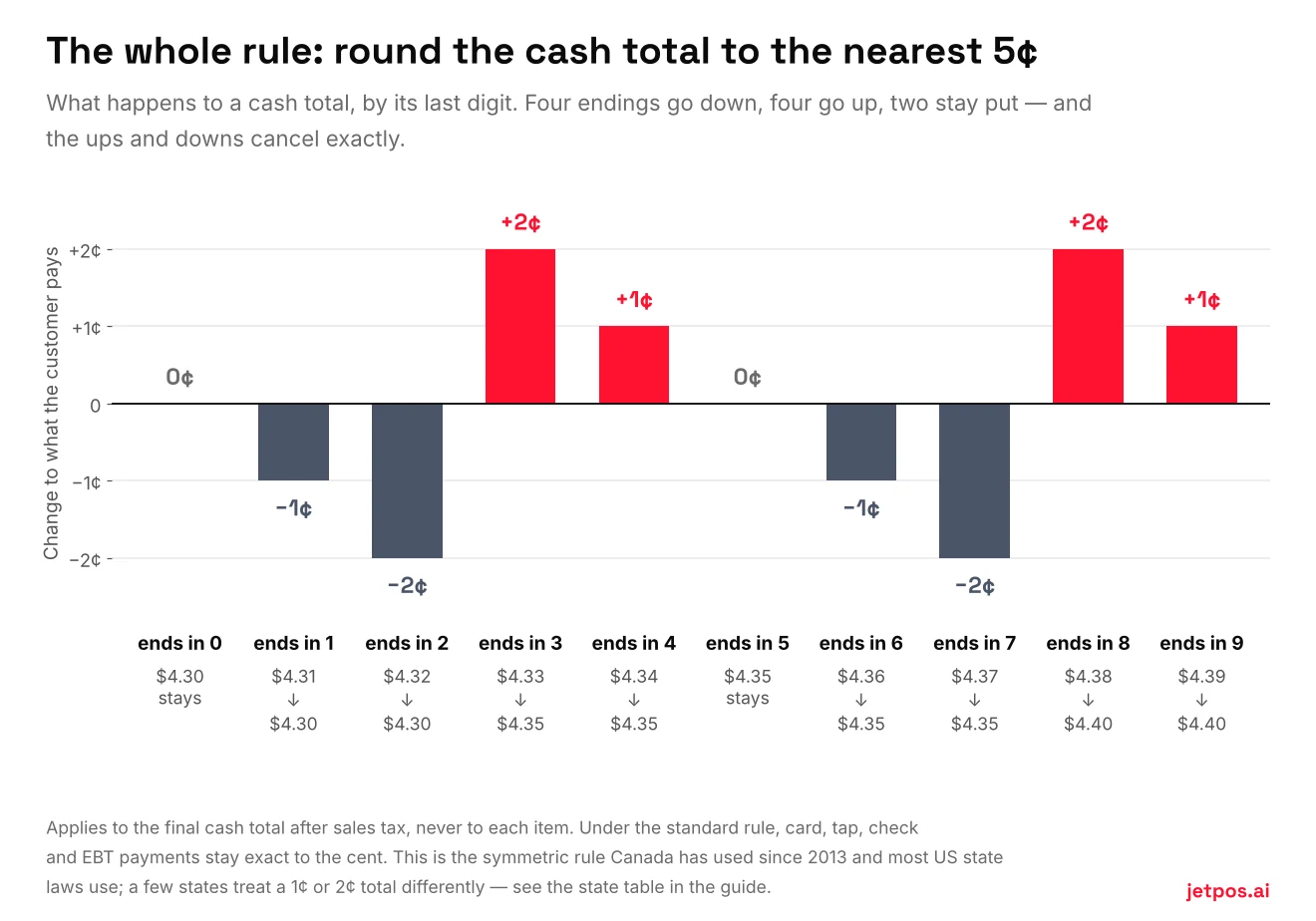
Two details trip people up.
Round the receipt, not the items. A $1.99 item and a $2.03 item make $4.02, which rounds to $4.00. Round each item first and you get $2.00 plus $2.05, which is $4.05: a different, wrong answer. Canada's rules say it in one word when asked whether to round individual prices: “No.”
Round after tax, never before. Sales tax is still worked out to the cent on the real, unrounded price, and only the amount the customer hands over in cash is rounded. Treasury's guidance says so, the federal bill rounds “the total transaction amount, including taxes,” and Canada has done it that way since 2013.
Tax is rounded to the nearest cent, then the cash total to the nearest 5¢. Leave tax at 0 for tax-free items. Under the standard cash-only rule, card payments are charged the exact “with tax” amount. Totals of 1¢ or 2¢ follow your state's rule.
Do you have to round to the nearest nickel?
Only in two states today. Arizona requires it when a store doesn't have or doesn't use pennies, and Georgia requires it for in-person cash sales. California joins them on July 1, 2027.
Fifteen more states have laws in force that allow rounding when you do it their way: Alabama, Florida, Hawaii, Idaho, Indiana, Kentucky, Maryland, Missouri, Nebraska, North Carolina, Oregon, Tennessee, Vermont, Virginia and Washington. Connecticut has passed one that is reported to start on January 1, 2027.
No federal law makes you round. The Common Cents Act would let you, but it doesn't require it, and it isn't law yet. In the other states no statute tells you either way. Rounding down is the low-risk direction almost everywhere. The exceptions are Arizona, whose law says that once you're out of pennies you use the standard rule and no other, and Georgia (and California from July 2027), whose laws spell out the standard rule with no round-down option. Rounding up is where the risk sits, and it is concentrated in a few cities. Find your state below.
Penny rounding laws by state
As of October 27, 2026, 23 states have passed a law that touches cash rounding. Nineteen of them cover private businesses; the other four cover only payments to government or liquor sales. Trackers online disagree, and several are wrong about Indiana, Minnesota and North Carolina, so we read the laws themselves wherever the legislature publishes them.
| State | Status | In force | What to know |
|---|---|---|---|
| Alabama | Allowed | Apr 17, 2026 | Round the total or the change. Payments to government are excluded. |
| Arizona | Required when you lack or don't use pennies | Mar 13, 2026* | Standard rule only, no other method. A sign with wording set by law must be visible at the register. |
| California | Required | July 1, 2027 | Physical stores. Totals of 2¢ or less aren't rounded; cash refunds are. Overrides conflicting local rules on rounding. |
| Connecticut | Allowed (reported) | Reported Jan 1, 2027 | Signed June 4, 2026. Until it starts, the state consumer agency says round down. |
| Florida | Allowed | May 11, 2026 | In-person cash. Protected from the state's deceptive-practices law, but it doesn't override local rules such as Miami-Dade's ban on charging cash customers more. |
| Georgia | Required | July 1, 2026 | In-person cash. A 1¢ or 2¢ total rounds up to 5¢. You must still accept exact payment. |
| Hawaii | Allowed | July 1, 2026 | A 1¢ or 2¢ total rounds up to 5¢. Covers cash wages too. No private lawsuits under it. |
| Idaho | Allowed | July 1, 2026 | Only when you can't settle to the cent. Applies to cash refunds. |
| Indiana | Allowed | Mar 15, 2026 | The business chooses: always down, always up, or nearest. The only state law that expressly allows always rounding up. |
| Kentucky | Allowed | July 15, 2026 | Only when pennies aren't available. |
| Maryland | Allowed | May 12, 2026 | Not when the customer pays exact. Overrides local rules. Covers cash wages. |
| Missouri | Allowed | Aug 28, 2026 | Cash only, on the final total after discounts and tax. |
| Nebraska | Allowed | Apr 15, 2026 | A 1¢ or 2¢ total rounds up to 5¢. Round the total or the change, not both, at each location. |
| North Carolina | Allowed | July 2, 2026 | Cash portion only; the customer may pay exact. Missed by most online trackers. |
| Oregon | Allowed | Apr 7, 2026 | Signs required. The customer may pay exact. |
| Tennessee | Allowed | Mar 18, 2026 | When you have no exact change. Exempt from the state consumer-protection act. |
| Vermont | Allowed | June 8, 2026 | Post the state's model notice. Cash refunds must be the exact amount paid. |
| Virginia | Allowed | July 1, 2026 | On the total including taxes. Covers cash wages. |
| Washington | Allowed | June 11, 2026 | In-person cash; the customer may pay exact. Overrides local rules. |
| New York | Passed, not signed | — | Would require rounding. Passed the Assembly in May and the Senate on June 3, 2026; not yet sent to the Governor. Meanwhile state and city law ban charging cash customers more. |
| Pennsylvania | Bill pending | — | Would require rounding when you can't make change. Passed the House in June 2026; in Senate Finance. Philadelphia bans charging cash customers more. |
| New Jersey | Bill pending | — | Would allow rounding. Passed the Assembly in September 2026. State guidance already allows it if disclosed clearly before you charge. |
| Michigan | Bill pending | — | Would require rounding down. State Treasury guidance allows up or down. |
| Massachusetts | Bill pending | — | Would allow disclosed rounding when exact change is impossible. State guidance asks for full disclosure. |
| Minnesota, New Mexico, Oklahoma | Government only | — | Cover cash paid to government, not private sales. |
| Utah | Liquor only | — | Other retail has state guidance: disclose your rounding method clearly. |
Dates are when each law took or takes effect for businesses. Everywhere not listed, there is no state rounding law as of October 27, 2026, though Texas, Iowa, Wisconsin, South Carolina and others have issued tax guidance: compute sales tax on the unrounded price. *Arizona's revenue department gives March 12; the signed law says March 13. Re-check pending bills before relying on them.
Can rounding up get you in trouble?
Yes, in a few specific places. New York City, New York State, Philadelphia and Washington, D.C. all ban charging a cash customer a higher price than other customers, and none of those laws has a rounding exception yet. Miami-Dade County has the same kind of ban, and Florida's rounding law doesn't say it overrides local rules. San Francisco bars putting a fee or condition on paying cash until California's rounding law takes over in July 2027.
Ring a $4.33 basket up to $4.35 for the cash customer while the card customer behind them pays $4.33, and the cash customer has paid more. Those laws don't mention rounding, but that is the price difference they forbid, and New York City's and Connecticut's consumer agencies both tell shops to round down.
New York City's consumer agency says you may round the total down, or the change up, to the nearest 5¢. You must disclose your policy and still accept pennies. Fines run up to $1,000 for a first violation.
New York State copied the city's rule statewide in March 2026. The state's rounding bill, which would require standard rounding, passed the Assembly in May and the Senate in June but had not been sent to the Governor as of October 28.
Philadelphia has no state rounding law to lean on, and a city bill would require rounding down.
Until that changes, round down.
Connecticut's consumer agency gives the same advice until its law starts: round down. Lawyers list Miami-Dade and San Francisco as unsettled too, so the cautious move there is the same. In several of the states that have passed rounding laws, following the law is expressly protected: Georgia, Arizona, Kentucky, Missouri, Nebraska and Virginia say compliance is not a violation of state or local rules, and Washington and Maryland override local ordinances outright.
We found no rounding lawsuit as of October 2026. But the convenience-store trade association has warned of class actions, and lawyers note that in Philadelphia and D.C. consumers can sue under consumer-protection law.
The federal Common Cents Act would settle this nationally if it becomes law.
What the federal Common Cents Act says
It lets you round. It doesn't make you. The House passed the Common Cents Act (H.R. 10167) by voice vote on September 14, 2026, and the Senate passed it by unanimous consent on September 28. As of October 28, 2026, it had not been signed into law, so check its status before you rely on it.
What the final text says:
- Permission, not a mandate. A business “may, if exact change cannot be provided,” round a cash total, and the bill adds that nothing in it may be construed to require any person to round. Its long title still says “to require”, a leftover from earlier drafts, which is why some headlines got this wrong.
- The standard rule. Totals ending in 1, 2, 6 or 7 cents round down; 3, 4, 8 or 9 round up. A total of exactly 1¢ or 2¢ may round up to 5¢.
- After tax. What gets rounded is “the total transaction amount, including taxes.”
- Cash only. It does not apply to card, check, electronic transfer, gift card or money order payments.
- Always fine in the customer's favor. Rounding a cash total down, or change up, is allowed at any time.
- A legal safe harbor. Once it's law, rounding the way the bill describes can't be treated as breaking any federal, state, tribal or local law. On its plain words, that reaches city rules like New York's and Philadelphia's bans on charging cash customers more; minimum-wage, overtime and paid-leave laws are carved out.
- No waiting period. The final text has no delayed start date, so it would apply from the day it becomes law.
Until it becomes law, the only federal word is Treasury's December 2025 guidance: businesses may round cash totals to the nearest nickel when they can't make penny change, should round only cash, and should round only after tax. Treasury labels it non-binding.
Does penny rounding cost your store money?
Not on a normal day's mix of sales. Done the standard way, the ups and the downs cancel out. Two situations don't cancel, and both are easy to fix once you know about them.
We didn't want to just assert that, so we ran it: one million simulated cash sales per scenario, baskets of one to five items at $0 to $14.99 each, with price endings we weighted toward the charm prices convenience stores use (.99, .49, .29 and similar), sales tax added on the subtotal, then rounded to the nearest nickel.
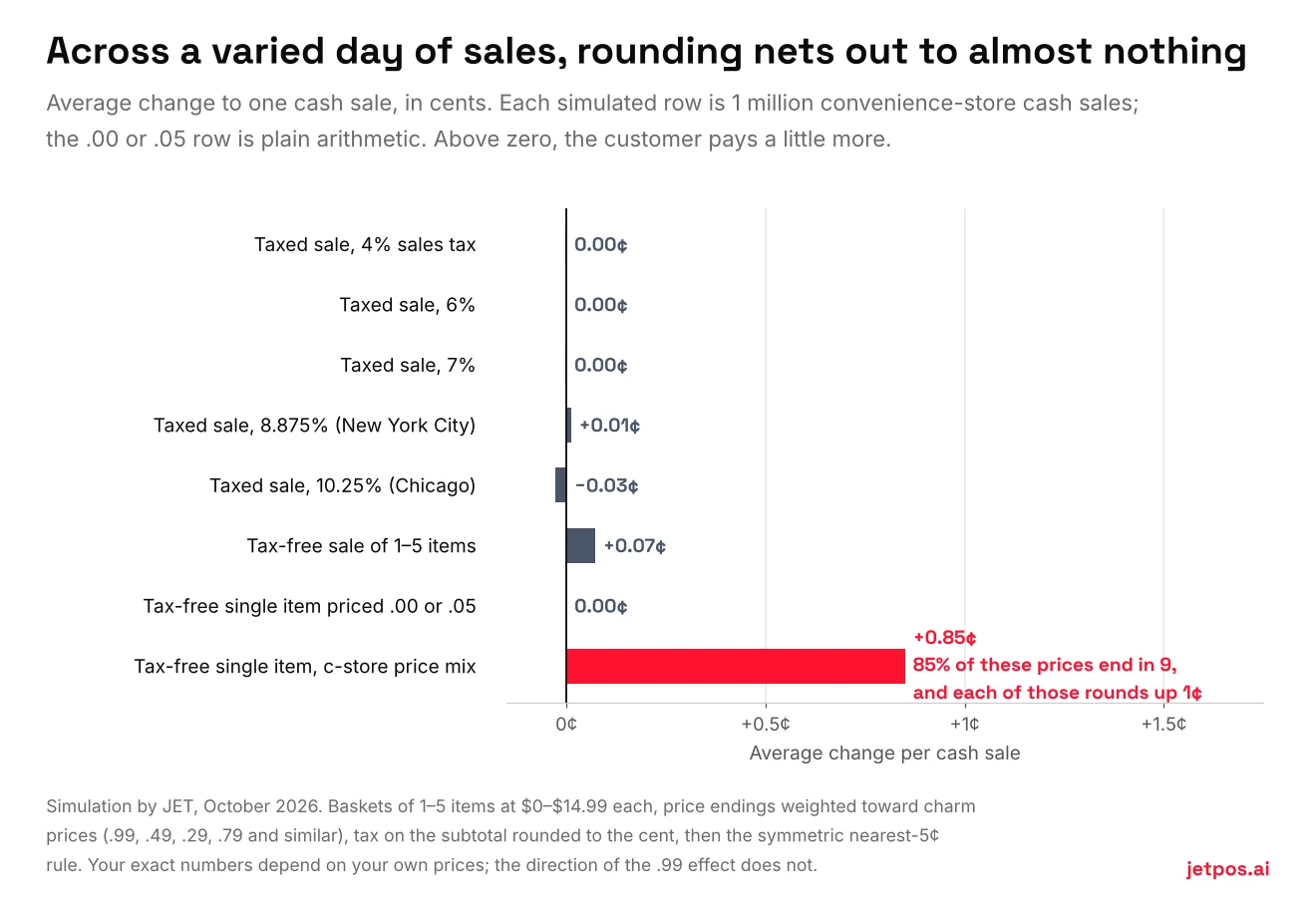
In dollars: at 250 cash sales a day, the largest average effect we saw, 0.03¢ a sale, comes to about $26 a year, and day-to-day luck adds or takes away up to about $8 more. So a full year ends within about $35 either way, and which way depends on your prices and tax rate, not on the rule. Less than a dime a day.
That matches the research. When economist Robert Whaples ran 185,714 real convenience-store transactions through the same rule, customers came out $105.60 ahead in total. His verdict: “The ‘rounding tax’ is effectively zero.” In 2025, Richmond Fed economists estimated that nickel rounding would cost US consumers about $6 million a year in total. For the whole country, not per store.
Exception 1: the item you sell over and over
A varied basket nets out. The same item rung up on its own does not: its cash total is identical every time, so it rounds the same way every time.
At New York City's 8.875% sales tax, a $2.50 item comes to $2.72 and rounds down to $2.70, 2¢ to the customer every time. A $2.00 item comes to $2.18 and rounds up to $2.20, 2¢ to you every time. Two cents is nothing once. On 200 sales a day it's about $1,460 a year, all in one direction.
Put your top five cash sellers through the calculator above. If your best seller always rounds against you, a few cents' change to its price fixes it for good.
Exception 2: tax-free items priced at .99
With no tax on top, a $1.99 item is a $1.99 cash total, and a total ending in 9 always rounds up: the customer hands over $2.00. Two of them make $3.98, which rounds up 2¢; three make $5.97, which rounds down 2¢. Sold one at a time, though, it is a cent your way on every sale.
A 2018 study simulated this for Canada. Using real grocery prices, most of them ending in 9, it estimated that rounding moves about CAD 3.27 million a year from shoppers to stores, around CAD 157 per store. Small, but always in the same direction.
That sounds like free money. In most of the country it's harmless. But in a city that bans charging cash customers more than card customers, it is exactly the pattern a complaint points to: the card customer paid $1.99, the cash customer paid $2.00, for the same thing.
Price tax-free items you sell singly to end in 0 or 5: $1.95 or $2.00 instead of $1.99. Rounding then never touches them, in either direction, and nobody can say cash customers pay more.
And if you'd rather never round up at all? Outside Arizona and Georgia that's a legitimate choice, and two-thirds of the large retailers surveyed by the Retail Industry Leaders Association in late 2025 made it. But know its price: round-down-only costs about 2¢ per cash sale on average. At 250 cash sales a day that's roughly $1,800 a year. Worth paying where rounding up is legally risky. Not worth paying anywhere else.
What Canada learned in 13 years without a penny
JET is a Montréal company, so this part is home turf. Canada's Mint struck its last penny on May 4, 2012 and stopped distributing them on February 4, 2013. The rules Ottawa issued are the ones US laws now copy: round cash only, round only the final amount after GST/HST, 1–2 and 6–7 down, 3–4 and 8–9 up, and leave cheques and electronic payments alone. The government put the savings at CAD 11 million a year.
The fear beforehand was a “rounding tax”. In 2001, economist Raymond Lombra estimated that US shoppers would lose at least $600 million a year. The evidence since says otherwise:
- Whaples' 185,714 real convenience-store transactions came out slightly in the customers' favor.
- The Bank of Canada told the Senate in 2010 that any impact on inflation would be “insignificant and more likely non-existent.”
- New Zealand's central bank told Canada's Senate that a consumer survey found prices fell slightly when New Zealand withdrew its 1¢ and 2¢ coins.
- In 2025, Atlanta Fed research put the effect of symmetric rounding on US cash prices at 0.001% to 0.01%: not statistically different from zero.
The one leak researchers keep finding is the one in our simulation: single, untaxed items priced at .99. Price those to end in 0 or 5 and Canada's experience says you can stop thinking about rounding.
The rules at the register
The law sets the rule. These are the habits that keep a drawer honest and a customer from arguing.
- Round cash only. Card, tap, phone-wallet, check and gift card payments are charged to the exact cent. Treasury recommends it, the federal bill only covers cash, and Toast, Square, NCR Aloha and Verifone all round cash only.
- Charge EBT to the cent. EBT is an electronic payment. Federal rules require SNAP shoppers to get the same prices and terms as cash customers; retail groups asked USDA in October 2025 how nickel rounding fits that rule, and we found no USDA answer as of October 27, 2026. The cautious approach: charge the SNAP part exactly and round only a cash remainder, or round that remainder down.
- Round the final total, once per receipt. After discounts and after tax, never line by line.
- Split payments: let the card take the odd cents. Treasury's guidance says split payments can be settled to the exact amount. Take the cash in round amounts and put the remainder on the card, and nothing needs rounding. (Square rounds the cash part instead, which is why paying cash first or card first can change its total by a few cents.)
- Round cash refunds the way you rounded the sale. That way you never pay back more or less than you took. Treasury leaves refund policy to you; Clover and Verifone both mirror the original sale.
- Show it on the receipt. A separate line, “Cash rounding −$0.02”, so the customer sees it and your drawer count matches the report. Treasury suggests showing the adjustment on receipts.
- Take pennies when they're offered. They are still legal tender, Treasury asks retailers to keep accepting them, and the federal bill's standard rule only applies when exact change can't be given. Georgia's law requires merchants to accept exact payment, and Washington, Oregon and Maryland let the customer pay the exact amount instead of a rounded one.
- Count the drawer against rounded totals. Your end-of-day report should show the day's total rounding, so a few cents' gap is explained, not a mystery.
How the big POS systems handle it
Most of the big POS makers added or opened up a US cash-rounding setting between late 2025 and mid-2026. They differ on whether it's finished, whether it touches card payments, and where it's switched on.
| POS | US cash rounding | What it rounds | Worth knowing |
|---|---|---|---|
| Toast | Built in (rolled out mid-2026) | Cash only, after tax | Three settings: always down, always up, or nearest nickel. Shows a “cash rounding” line and keeps it out of net sales. |
| Square | Open beta, app 6.84 or newer | Cash only, tax on the unrounded amount | Not available in Connecticut. On split payments it rounds the cash part, so paying cash first or card first can change the total. |
| Clover | In Clover's developer docs | Cash only or all payments, depending on setup | We found no merchant help article for US rounding. Ask your Clover provider before you count on it. |
| Shopify POS | Not announced for US dollars (Shopify staff, June 2026) | — | Some US merchants report a native opt-in since July 2026. Third-party apps fill the gap, such as Roundly at $5 a month. |
| Lightspeed | Unclear for US dollars | The cash payment type | Rounding is set by currency; its help pages don't say US dollars are supported. |
| NCR Aloha, Verifone Commander, Gilbarco Passport | Built in | Cash only (Aloha, Commander) | Aloha is NCR Voyix's restaurant POS; Commander and Passport run many gas stations and convenience chains. |
| Loyverse | Built in, any currency | Cash only | A free POS. Rounds to 5¢, 10¢, 50¢ or $1. |
| JET | Rounds every payment, JET Retail and JET Resto | The whole bill to the nearest 5¢, card payments included | An on/off option at no extra cost, with no cash-only mode. The cashier can skip rounding on a sale paid exactly. See the next section. |
Compiled from each vendor's own help, developer and release documentation, and staff and merchant forum posts, checked October 27, 2026. Features in beta change quickly; confirm with your provider.
How it works on JET
Our row in that table, spelled out so you can hold us to it.
The option. JET Retail and JET Resto both have a rounding option you turn on or off. In JET Resto it sits under Settings, then Cashier Settings, then Decimal Point Setting, then Rounding.
What it rounds. The whole bill, to the nearest 5¢, whatever the customer pays with. Turn it on and a $4.33 sale comes to $4.35, and a $4.32 sale to $4.30, on a card as well as in cash.
Exact change still works. When a customer has the exact amount, pennies included, the cashier can skip rounding on that sale.
What that means for you. Cash and card customers pay the same total, so a cash customer is never charged more than a card customer. But it is not the cash-only rounding Treasury recommends: card totals are rounded too, by up to 2¢ either way, and neither the federal bill nor any state rounding law covers rounding a card payment, so their legal protections apply only to the cash side. If you'd rather keep card payments exact to the cent, leave the option off.
What it costs. Nothing extra. JET's software is $0 a month with every feature unlocked, on hardware you buy once, so rounding isn't a plan tier or an add-on.
No cash-only rounding mode. JET's option rounds every payment type, and rounding laws protect only cash rounding. Toast and Square round cash only.
Android only. No iOS build. If you're committed to iPads, we're the wrong system.
What we'd do this week
- Find your state in the table above. If your state requires rounding, note the start date. If you're somewhere that bans charging cash customers more and no rounding law covers you yet, round down until one does.
- Turn on cash rounding in your POS, then test it. Ring five cash sales whose totals end in 1, 3, 6, 8 and 9, and one card sale. Check that each moves the way you expect, and that you know whether your system touches card payments.
- Check your best sellers. Put your top five cash items through the calculator at your tax rate. Anything that always rounds against you gets a small price change.
- Reprice tax-free items you sell on their own. Anything ending in .99, .49 or .29 that leaves as a single cash sale: move it to .95 or .00.
- Put a sign at the register that says what you actually do. Rounding cash to the nearest 5¢: “Cash totals are rounded to the nearest 5¢. Card payments are charged to the exact cent.” Rounding down only: “Cash totals are rounded down to the nearest 5¢.” If your system rounds card payments too, as JET's option does, leave out the card sentence. Arizona sets the exact wording by law, Vermont requires the state's model notice, and Oregon's sign must describe your procedure.
- Give every cashier the three rules: cash only, the whole receipt, after tax. And take pennies when a customer offers them.
- Look at your end-of-day report after a week. The rounding total should be small and swing both ways. If it only ever goes one way, check your best sellers again.
The penny isn't coming back. A rounding setting, five test sales and a few repriced items, and it stops being something you think about.